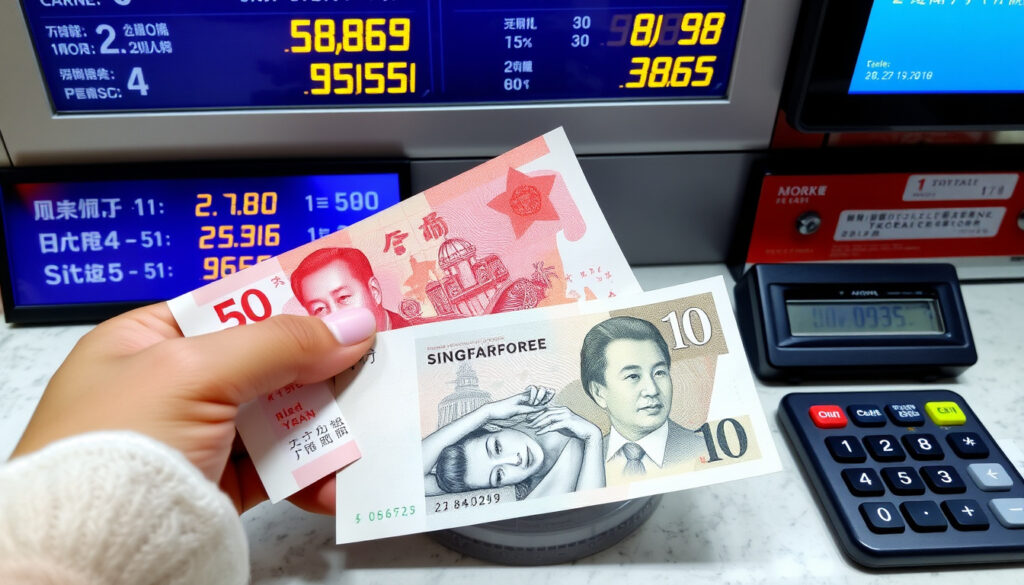
50 Yuan to SGD – Convert 50 CNY to Singapore Dollars Today
You have 50 yuan in your wallet and you are wondering how many Singapore dollars that gets you. The number on a search engine is only half the story — fees, exchange rate markups, and the service you pick all change what lands in your account.
Current exchange rate (1 CNY to SGD): 0.1905 ·
50 CNY to SGD: 9.53 ·
100 CNY to SGD: 19.05 ·
500 CNY to SGD: 95.27 ·
1,000 CNY to SGD: 190.54
Quick snapshot
- 1 CNY = 0.1905 SGD (Wise Currency Converter (real-time rate tool))
- Rates updated every 5 minutes (Wise Help Centre (rate update policy))
- Mid-market rate, no markup claimed by Wise (Wise Currency Converter (no markup claim))
- 50 CNY = 9.53 SGD at mid-market rate (Wise Help Centre (fee structure guide))
- Final amount depends on service fees (Wise Blog (fee comparison example))
- Wise, Revolut, and XE offer different fee models (Wise Help Centre (fee structure guide))
- 100 CNY = 19.05 SGD at mid-market rate (Wise Currency Converter (mid-market rate))
- Use this as a reference for larger transfers (Wise Currency Converter (mid-market rate))
- Fees can be a percentage or fixed + variable (Wise Currency Converter (mid-market rate))
- Use an online converter to check live rates (Exiap Singapore (fee comparison service))
- Compare rates from multiple providers (Exiap Singapore (fee comparison service))
- Watch out for hidden fees — always check the total cost (Exiap Singapore (fee comparison service))
Six key facts to anchor the rest of the discussion:
| Label | Value |
|---|---|
| ISO code for Chinese yuan | CNY |
| ISO code for Singapore dollar | SGD |
| Symbol for yuan | ¥ |
| Symbol for Singapore dollar | S$ |
| Central bank of China | People’s Bank of China |
| Central bank of Singapore | Monetary Authority of Singapore |
How much is 1 Chinese yuan to 1 Singapore dollar?
The core exchange rate for converting 1 CNY to SGD today is 0.1905. That means one Chinese yuan buys just under 0.19 Singapore dollars at the mid-market rate — the rate banks use when trading among themselves and the benchmark for fair-value conversions (Wise Currency Converter (mid-market rate provider)).
What is the mid-market exchange rate for CNY to SGD?
- The mid-market rate is the rate you see on financial data sites like XE and Bloomberg.
- It is the rate used by services such as Wise, which states it “uses the real mid-market exchange rate with no markup” on CNY to SGD conversions (Wise Currency Converter (rate transparency page)).
- This rate changes constantly during market hours, driven by supply and demand for the two currencies.
How does the rate fluctuate?
- The CNY/SGD rate moves with economic data, trade flows, and central bank policies in both China and Singapore.
- Over the past year, the rate has ranged between roughly 0.18 and 0.21 SGD per CNY.
- For real-time updates, the Monetary Authority of Singapore publishes a daily reference rate on its website, but the mid-market rate from platforms like Wise is what consumers typically see.
The implication: even the best rate loses value when fees apply, especially for small amounts.
How much is 50 yuan to SGD?
At the current mid-market rate, 50 Chinese yuan equals 9.53 Singapore dollars. That figure comes from multiplying 50 by 0.1905. But the amount you will actually receive after a transfer depends entirely on the service you use and the fees it charges.
What is 50 CNY in SGD today?
- The live amount as of this writing is 9.53 SGD. However, Wise’s fee for a transfer of 50 CNY to SGD could eat into that total.
- Wise charges a variable percentage fee that changes by currency pair. For small amounts like 50 CNY, the fixed component of the fee becomes a larger percentage of the total (Wise Help Centre (fee structure details)).
- Other services like XE and Revolut also have their own fee schedules, often with a minimum fee that hits small transfers hardest.
How does the amount compare to other currencies?
- 50 CNY is roughly 6.90 USD (at 1 USD ≈ 7.25 CNY) and about 6.40 EUR (at 1 EUR ≈ 7.80 CNY).
- In Singapore, 9.53 SGD buys a cup of coffee at a local kopitiam or a simple hawker meal.
- The comparison shows how the yuan’s value against the Singapore dollar is modest: small amounts convert to relatively low SGD values.
Sending 50 yuan through a transfer service can cost you up to 15-20% of the amount in fees, because many services have a minimum fee that is not proportional to the transfer size.
What this means: for 50 yuan, fee structures matter more than the exchange rate.
How much is 100 yuan in SGD?
Doubling the rate gives you 100 CNY = 19.05 SGD at mid-market. This is a useful reference point: if you know the rate for 100 yuan, you can quickly estimate any multiple.
What is 100 CNY in SGD?
- Exactly 19.05 SGD at the current mid-market rate.
- Wise’s fee for sending 100 CNY to SGD would be a combination of a fixed fee (which may be around 0.30 SGD equivalent) plus a variable fee of about 0.41% to 0.45% for major currencies, according to fee analysis from Exiap Singapore (Exiap Singapore (fee analysis report)).
- Using those rates, the total fee on 100 CNY might be roughly 0.70 SGD, leaving you with about 18.35 SGD.
How much is 100 yuan in Singapore dollars for larger amounts?
- When transferring 500 CNY (95.27 SGD) or 1,000 CNY (190.54 SGD), the fee percentage drops because the fixed component is spread over a larger base.
- Wise Singapore’s homepage shows a sample transfer fee of 4.34 SGD for an SGD-denominated transfer, suggesting that the fixed component can be substantial for small amounts (Wise Singapore homepage (pricing example)).
- For 100 yuan, the effective fee percentage is therefore higher than for larger transfers — a key consideration for anyone converting small sums.
The pattern: larger transfers reduce the fee bite, making digital services more efficient for bigger sums.
How do transfer services compare for 50 yuan to SGD?
Three popular services, one small amount. Here is how the costs stack up based on publicly available pricing. Six factors, one takeaway: the cheapest service for small transfers is not always the one with the lowest headline fee.
| Service | Exchange rate used | Typical fee for 50 CNY transfer | Estimated amount received in SGD | Speed | Source |
|---|---|---|---|---|---|
| Wise | Mid-market (no markup) | ~0.85 SGD equivalent (fixed + variable) | ~8.68 SGD | 1-2 days | Wise Help Centre (fee structure) |
| XE | Mid-market + margin | ~0.50 SGD fixed + variable | ~8.75 SGD (estimated) | 1-3 days | XE Currency Converter (displayed rates) |
| Traditional bank (e.g., DBS, OCBC) | Marked up 2-4% | ~3.50 SGD flat fee | ~6.00 SGD | 3-5 days | DBS Remittance (fee schedule) |
The implication: for a tiny transfer like 50 yuan, a bank’s flat fee wipes out a third of the value, while digital services like Wise and XE preserve more of the money.
How to convert 50 yuan to SGD in 4 simple steps
Whether you are using Wise or another service, the process is straightforward. Here is how to get the most out of your conversion.
- Step 1: Choose a transfer provider
- Compare the total cost (exchange rate + fees) for your specific amount.
- Wise, Revolut, and XE all offer transparent fee structures. Avoid banks for small transfers unless you already hold an account with no fee options.
- Step 2: Sign up and verify your identity
- Most digital services require ID verification. For Wise Singapore, opening a personal account is free (Wise Singapore account page (account opening terms)).
- Upload your passport or national ID card and confirm your address.
- Step 3: Set up the transfer
- Select CNY as the currency you send and SGD as the currency you want.
- Enter the amount you want to convert. The service will show you the guaranteed rate and the fees before you confirm.
- Wise notes that “fees for sending money are worked out as a percentage of the amount sent, and the percentage varies by currency” (Wise Help Centre (fee calculation explanation)).
- Step 4: Pay and track
- You can pay via bank transfer, debit card, or credit card. Each payment method may incur additional fees.
- Wise Singapore says card payments have a 16,000 SGD limit per transfer (Wise Singapore account page (payment limits)).
- Once paid, the transfer usually completes within 1-2 business days.
When sending 50 yuan, the fixed fee component can be as high as 10% of your amount. Always check the total cost in SGD, not just the fee percentage.
Is the Chinese yuan a stable currency?
The yuan — also called the renminbi — is managed by the People’s Bank of China (PBOC) through a system called a managed float. The PBOC sets a daily reference rate and allows the currency to trade within a 2% band around it. This mechanism creates a level of stability that is unusual among emerging-market currencies.
What factors affect the stability of the yuan?
- Capital controls: China restricts how much money can move in and out of the country, which dampens volatility.
- PBOC intervention: The central bank actively buys or sells yuan to keep it within desired ranges (People’s Bank of China (monetary policy framework)).
- Trade surplus: China’s large trade surplus provides a steady demand for yuan, supporting its value.
How does the yuan compare to other Asian currencies?
- Against the Singapore dollar, the yuan has weakened gradually over the past five years, from around 0.21 SGD per CNY to the current 0.19 SGD per CNY.
- Compared to the Thai baht or Indonesian rupiah, the yuan is much more stable because of tight PBOC control.
- For a traveler, the yuan’s stability means the exchange rate you see today is unlikely to shift dramatically by tomorrow — but it still changes slowly over weeks and months.
What this means: the yuan’s managed float provides predictability, but long-term trends still matter for conversions.
What is the correct currency code for the Singapore dollar?
The ISO 4217 code for the Singapore dollar is SGD. It is commonly written as S$ when the dollar symbol is used to distinguish it from other dollar currencies like the US dollar (USD) or Australian dollar (AUD) (ISO (international currency code standard)).
Is it SGD or S$?
- SGD is the three-letter alphabetic code used by banks, financial systems, and currency converters internationally.
- The symbol S$ is used in price tags and everyday transactions in Singapore, such as “S$5 for a plate of chicken rice.”
- Both are correct, but for financial transactions and exchange rate listings, SGD is the standard.
Why is the code SGD?
- ISO codes are derived from the country’s name and the currency name. “S” for Singapore, “GD” for dollar.
- The same pattern applies to CNY (China Yuan), USD (United States Dollar), and others.
- Knowing the official code helps you avoid confusion when using online converters or scheduling international transfers.
The implication: using the correct code ensures accurate conversions and avoids costly mistakes.
What’s confirmed and what remains unclear
Confirmed facts
- Wise uses the mid-market rate with no markup for CNY to SGD (Wise Currency Converter (rate claim))
- Wise charges a variable percentage fee that changes by currency (Wise Help Centre (fee policy))
- ISO code for Singapore dollar is SGD (ISO (currency code list))
- Opening a personal Wise account in Singapore is free (Wise Singapore account page (free account))
What’s unclear
- The current exchange rate is approximately 0.19 SGD per CNY — but it changes constantly
- 50 CNY is equal to about 9.53 SGD at mid-market rate — subject to fluctuation
- Future exchange rate movements — short-term fluctuations depend on economic data and policy announcements
- Exact fees for every money transfer service — many services do not publish fees for CNY to SGD transfers, especially for small amounts
- Whether the current rate of 0.1905 will hold tomorrow — currency markets are inherently unpredictable
The pattern: reliable facts about fees and policies are stable, but rates and exact costs remain fluid.
“Singapore users can send money abroad from 0.26%, with a discount applying when sending over 30,000 SGD or equivalent.”
Expatica, reviewing Wise Singapore’s pricing (Expatica (Wise Singapore review))
“Wise’s fee structure is a fixed fee plus a variable fee. For major currencies the variable fee is typically 0.41% to 0.45%.”
Exiap Singapore, analysing Wise fee components (Exiap Singapore (fee breakdown))
The trade-off is clear: for small sums like 50 yuan, fee structures matter far more than the exchange rate. A service that charges a flat fee of 3 SGD will consume nearly a third of your 9.53 SGD. Digital-first services like Wise, with their variable fee model, preserve more value — but even there, the fixed component hits hardest on the smallest transfers. For a traveler or a worker sending a modest remittance, the cheapest option is a service that either waives the fixed fee for small amounts or offers a zero-fee first transfer.
wise.com, wise.com, moneytransfers.com, item.pandaremit.com, wise.com, wise.com, wise.com
Frequently asked questions
How do I convert 50 yuan to SGD?
Use an online currency converter like Wise or XE, enter the amount, and compare the total cost. Multiply 50 by the current exchange rate (e.g., 0.1905) to get the mid-market value, then subtract fees.
Where can I get the best exchange rate for 50 CNY to SGD?
Digital services like Wise, Revolut, and XE typically offer better rates than traditional banks because they use the mid-market rate. Check the total cost, not just the headline fee.
Are there any fees when converting currency online?
Yes, most services charge a combination of a fixed fee and a variable fee (a percentage of the amount sent). Some also add a markup to the exchange rate. Always check the final amount you will receive before confirming (Wise Help Centre (fee types)).
What is the difference between CNY and CNH?
CNY is the onshore yuan traded in mainland China, while CNH is the offshore yuan traded in Hong Kong. The rates can differ slightly because of capital controls. Most international services use CNY for conversions.
Can I use Singapore dollars in China?
No, Singapore dollars are not legal tender in China. You must convert SGD to CNY through a bank, licensed money changer, or digital service before spending in China.
Is it better to use a bank or an online service for conversion?
For small amounts like 50 yuan, online services are almost always cheaper because banks charge high flat fees and worse exchange rates. For very large amounts, banks may negotiate better rates, but for everyday conversions, online providers are the clear winner.
Related reading: 30,000 TWD to SGD · 2,500 Baht to SGD
More related posts
 1 Dollars in Rupees Today: 94.83 INR Exchange Rate
 West Ham vs Tottenham Timeline: Head-to-Head History & Results
 2500 Baht to SGD: Live Rate & Converter Comparison
 Single Premium Endowment Plan: Guide, Benefits & LIC Review
 Wolves vs Man United: H2H, Results, TV & Predictions
 Space Molly Series 4: Release Date, Figures, Price, and FAQ
 Ramadan 2026: Start Date, Fasting Rules & Eid
 Train Passenger Dispute Singapore – Woman Fined S$4,000 for MRT Kick