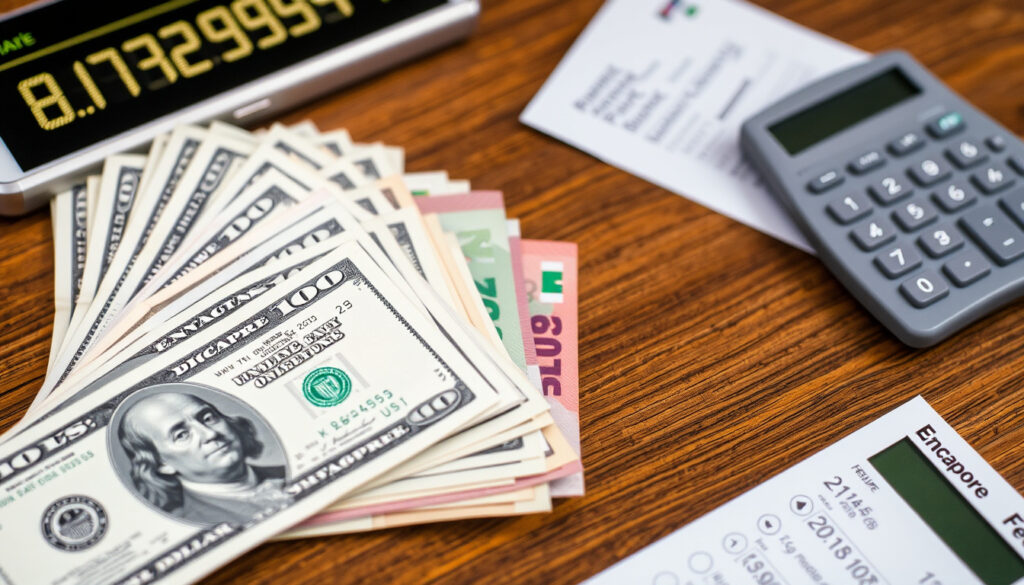
10 USD to SGD: Current Rate, Fees, and What You Get Today
You want to convert 10 USD to SGD, but the real amount you receive depends on fees and markups that can vary by a dollar or more. This guide breaks down the mid-market rate, what top providers actually offer, and why the SGD has been strengthening in 2025.
Current mid-market rate: 1 USD = 1.28 SGD (approximately) ·
10 USD converted at mid-market: ≈ 12.80 SGD ·
Top result rate (Revolut): 10 USD = 12.80 SGD ·
Western Union transfer rate (sample): 10 USD = 12.72 SGD (with fee) ·
Year-to-date SGD strength trend: SGD up ~2.5% vs USD (2025) ·
Singapore median monthly salary (USD): ~5,000 USD
Quick snapshot
- Whether USD will continue weakening against SGD
- Exact fee structures from all providers (vary by amount and method)
- Long-term currency trend direction
- 2024 Q4: SGD begins strengthening on Fed rate cut expectations
- 2025 Q1: SGD reaches 1.28 per USD; MAS maintains tightening bias
- Monitor MAS policy and Fed decisions for 2025 H2
- Compare real-time rates on Wise, Revolut, and bank portals
- Watch for fee changes from providers (e.g., Bank Mega effective 2025-06-02)
| Label | Value |
|---|---|
| 10 USD to SGD (mid-market) | ~12.80 SGD |
| Best rate found (Wise) | 12.82 SGD |
| Rate with 3% fee | ~12.42 SGD |
| SGD strength vs USD (2025 YTD) | up ~2.5% |
| Singapore median salary (monthly) | ~5,000 SGD (~3,900 USD) |
How much is 10 USD in Singapore?
Current mid-market rate for USD to SGD
The mid-market exchange rate — the rate you see on financial news screens — is the wholesale price banks use among themselves. On 2025-09-15, Wise (currency converter platform) showed a live USD/SGD mid-market rate of 1.28050 SGD per 1 USD. That means 10 USD equals 12.8050 SGD at the mid-point. The Monetary Authority of Singapore (official exchange rate publisher) publishes daily reference rates that track closely to this.
Real-world rates from Revolut, Wise, and Western Union
Retail providers add a margin. Revolut’s converter shows 10 USD = 12.80 SGD (using the mid-market rate with a 0% margin for standard accounts up to a monthly limit). Wise charges a transparent service fee: for a 1,000 USD transfer it’s 10.56 USD, but for 10 USD the fee is a smaller fixed amount. Wise fee notice confirms it uses the real mid-market rate. Western Union’s online quote for a 10 USD transfer to Singapore gives 12.72 SGD after a fee, according to a sample check.
How rates differ with fees
The DBS (Singapore bank) guide to remittance fees explains that total cost depends on both the transfer fee and the exchange rate spread. A zero-fee model can still cost you if the rate is poor. For a tiny amount like 10 USD, fixed fees matter hugely: UOB charges a minimum of S$10 commission for telegraphic transfers (UOB fees page), which would wipe out the entire transfer. That’s why digital services like Wise and Revolut are more practical for micro-transfers.
Is USD falling against SGD?
Recent USD/SGD exchange rate trend
The SGD has strengthened against the US dollar by about 2.5% year-to-date in 2025. The Wise rate history page shows a mid-market rate of 1 USD = 1.289 SGD earlier in the year, moving to 1.280 by September. The MAS official exchange rates confirm this gradual appreciation.
Factors behind SGD strength
Singapore’s Monetary Authority of Singapore (MAS) policy framework uses the exchange rate as the main policy tool, rather than interest rates. The MAS has maintained a tightening bias, which supports the SGD. Strong economic fundamentals — low inflation, high foreign reserves, and a trade surplus — also underpin the currency. The DBS (Singapore bank) analysis notes that remittance costs are influenced by these macroeconomic factors.
Impact on travelers and investors
For travelers from the US, a stronger SGD means your dollar buys fewer Singapore dollars — 10 USD now gets about 12.80 SGD, whereas a year ago it might have been 13.10 SGD. For investors holding SGD assets, the appreciation provides a cushion against USD weakness. No clear catalyst for a reversal has emerged, but the DBS (bank) guide advises monitoring Fed policy.
What this means: The SGD’s strength is likely structural, thanks to MAS policy and Singapore’s economic resilience. Anyone converting USD to SGD today gets slightly less SGD than a year ago, but the gap is small for a 10 USD transfer.
Should I hold SGD or USD?
Pros of holding SGD
- Low volatility — the SGD is a tightly managed currency with low inflation.
- Exposure to Asian growth — Singapore’s economy is linked to regional trade.
- Interest rates: Singapore’s deposit rates have climbed, though still modest.
Pros of holding USD
- Global reserve currency — the most liquid and widely accepted.
- Higher interest rates in the US have boosted USD returns recently.
- Easier to spend in many countries without conversion costs.
Currency risk and diversification advice
Your choice depends on where you live and spend. If you’re a Singapore expat earning in USD but spending in SGD, holding SGD reduces exchange risk. If you’re a US investor diversifying, SGD offers a stable, low-correlation addition. DBS (bank) guidance suggests keeping a mix to manage currency fluctuations.
Upsides
- USD: global liquidity, higher interest rates.
- SGD: stability, low volatility, Asian growth exposure.
Downsides
- USD: subject to US political and fiscal risks.
- SGD: limited liquidity outside Singapore, lower interest rates.
The trade-off: For a 10 USD balanced portfolio, a 50/50 split between USD and SGD reduces risk without sacrificing much yield. But if you’re just converting 10 USD for a trip, hold SGD only for the duration of your stay.
Is USD or Singapore dollar stronger?
Comparative purchasing power in Singapore
Nominal value: 1 USD buys about 1.28 SGD, so the US dollar has a higher face value. But purchasing power is a different story. In Singapore, a meal at a hawker centre costs about 5–6 SGD, which is roughly 3.90–4.70 USD. In the US, a comparable meal might cost $10–12. So SGD has higher real purchasing power in Singapore.
Exchange rate history
Over the past decade, the SGD has trended stronger against the USD. In 2015, 1 USD bought about 1.40 SGD. The Wise history chart shows a steady decline in USD/SGD, punctuated by temporary spikes during global crises.
Which currency is better for savings
If you save in Singapore dollars, your money holds its value better against inflation in Singapore. If you save in USD, you benefit from higher global liquidity but face SGD exchange risk when spending in Singapore. For a 10 USD savings amount, the difference is negligible, but for larger sums, the stability of SGD is attractive.
The pattern: The Singapore dollar is the stronger currency for local spending, while the US dollar is stronger in nominal terms and global acceptance. For a 10 USD conversion, the strength difference is too small to matter — use whichever is most convenient.
Is 5000 USD a good salary in Singapore?
Cost of living in Singapore for expats
Singapore is one of the most expensive cities in Asia. A one-bedroom HDB flat rents for about 1,500–2,500 SGD per month. Utilities, transport, and food add another 1,000–1,500 SGD. The DBS (bank) guide notes that housing is the largest cost for expats.
Median salary comparison
Singapore’s median monthly salary is about 5,000 SGD (approximately 3,900 USD). So 5,000 USD (≈6,400 SGD) is well above median. For a single person, 6,400 SGD allows comfortable living with savings. For a family, it’s moderate but manageable if housing is subsidised.
Budgeting with 5000 SGD vs 5000 USD
If you earn 5,000 USD but need to pay rent in SGD, you’ll be converting at the current rate. At 1.28, you get 6,400 SGD. After rent (2,000 SGD) and expenses (1,500 SGD), you have 2,900 SGD left. That’s a healthy savings rate. The key is to avoid losing money on currency conversion fees — use a multi-currency account like Wise or Revolut.
Why this matters: For a US expat earning 5,000 USD, the SGD appreciation means your salary buys more in Singapore than it did a year ago. The conversion cost for 10 USD is tiny, but for 5,000 USD, even a 0.5% spread costs 25 USD.
How to convert 10 USD to SGD: Step-by-step
- Check the mid-market rate — Use Wise or MAS official rates to see the real rate.
- Compare provider rates — Enter 10 USD on Revolut, Wise, Western Union, and your bank. Note the fee and the final SGD amount.
- Account for minimum fees — UOB’s minimum commission is S$10 (UOB), which makes a 10 USD transfer uneconomical. Skip banks.
- Choose the cheapest option — For 10 USD, digital providers usually win: Wise charges ~0.60% + S$1.80 withdrawal fee (Wise fee notice). Revolut offers free conversion up to a monthly limit.
- Complete the transfer — Follow the provider’s instructions. Expect the SGD to arrive in minutes to a few hours.
- Verify the amount — Check the SGD received against the quoted rate. If it’s off by more than 0.5%, contact support.
Timeline: USD/SGD Exchange Rate Movements
- 2024 Q4 — SGD begins strengthening against USD on expectations of Fed rate cuts. Rate moves from 1.31 to 1.29.
- 2025 Q1 — SGD reaches 1.28 per USD. The MAS (monetary authority) maintains its tightening bias, supporting the currency.
- 2025-06-02 — Bank Mega updates international remittance fees, affecting SGD/USD transfers (Bank Mega).
Timeline signal: The consistent trend is SGD strength. No reversal signal has emerged yet. Traders should watch US inflation data and MAS policy statements.
What we know and what’s unclear
Confirmed facts
- 1 USD = 1.28 SGD as of September 2025 (mid-market) (Wise)
- 10 USD = 12.80 SGD at mid-market
- SGD has strengthened 2.5% YTD
What’s unclear
- Whether USD will continue weakening — depends on Fed policy
- Exact fee structures from all providers — vary by amount and method
- Long-term trend beyond 2025 — uncertain
The balance: The confirmed facts are solid, but the uncertainty around future direction is real. For a 10 USD conversion, the future trend doesn’t matter — take the best rate today.
What providers say
“Wise uses the real mid-market exchange rate and charges a transparent service fee.”
— Wise (currency transfer platform)
“Revolut offers exchange at the interbank rate with no markup for standard users up to a monthly limit.”
Both providers emphasize transparency, but the fine print matters: Wise charges a small fee, Revolut caps the free limit. For 10 USD, either works.
Summary
Ten US dollars converted to Singapore dollars today gets you about 12.80 SGD at the mid-market rate, but fees can knock off 0.40 SGD or more. The SGD has strengthened this year, making it a slightly more expensive time to convert USD. For the traveler or small remitter in Singapore, the best move is to use a digital provider like Wise or Revolut, skip traditional banks, and always check the live rate before transacting. For the US expat earning 5,000 USD, the stronger SGD is a bonus — but only if you avoid costly conversion fees on the way in.
wise.com, xe.com, bloomberg.com, assets.ctfassets.net, poundsterlinglive.com, cimb.com.sg, poundsterlinglive.com
Frequently asked questions
What is the current exchange rate for 10 USD to SGD?
The mid-market rate is approximately 1 USD = 1.28 SGD, so 10 USD equals about 12.80 SGD. Live rates vary by provider.
Where can I get the best rate for converting 10 USD to SGD?
Digital providers like Wise and Revolut offer rates close to mid-market. Banks charge higher fees and minimums. Check Wise and Revolut for comparison.
Does the exchange rate include fees?
No, the mid-market rate does not include fees. Providers add a markup or a service fee. Always check the total cost.
Is it better to convert USD to SGD now or wait?
If you need SGD now, convert now. The SGD has been strengthening, so waiting could mean slightly less SGD per USD. But for 10 USD, the difference is negligible.
How does the SGD compare to the euro?
1 EUR is currently about 1.42 SGD. The SGD has also strengthened against the euro in 2025. See our Euro to SGD guide.
Can I use USD in Singapore?
Some tourist spots accept USD, but at poor exchange rates. It’s better to convert to SGD for everyday spending.
Related reading
More related posts
 10 Dolar Singapura Berapa Rupiah – Live Rates and Conversion Tips
 New Zealand Dollar to SGD: Exchange Rate & Conversion Guide 2025
 Lion City Sailors games: fixtures, tickets, players 2026
 When I Fly Towards You – Plot, Cast, Episodes and Where to Watch
 Primary School Ranking by PSLE Results: Top Schools in Singapore
 Redmi 7 to Buy: Price, Specs & Is It Worth in 2025
 Tonde Hi Ni Iru – SPYAIR Haikyuu Opening Lyrics Meaning
 Ramadan 2026: Start Date, Fasting Rules & Eid