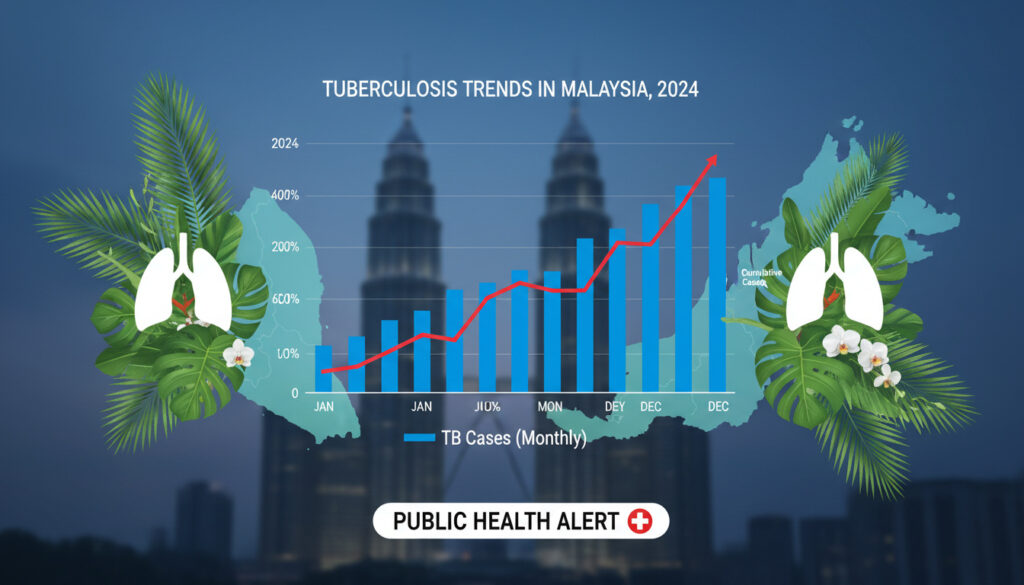
TB Cases in Malaysia – 2024 Statistics, Trends and Insights
Malaysia recorded approximately 34,000 tuberculosis cases in 2024, maintaining stability after years of concerning increases that saw infections reach four-decade highs. The persistent burden of TB, described by health experts as a “slow-burn epidemic,” continues to challenge public health infrastructure despite the disease being preventable and curable with early detection.
The statistical landscape reveals a complex picture of regional disparities, potential under-reporting, and shifting demographic patterns that contradict common misconceptions about the disease’s transmission. While official figures show stabilization, World Health Organization estimates suggest the actual incidence may be significantly higher than reported national data indicates.
How Many TB Cases Are There in Malaysia?
Total Cases 2024
Per 100,000 Incidence
WHO Estimated Rate
YoY Change
- WHO data indicates 43,000 cases in 2023, representing a 10.26% increase from 2022’s 39,000 cases
- Ministry of Health Malaysia reported 26,781 cases in 2023, a 5.5% increase from 2022’s 25,391 cases
- Since 2000, annual case counts have increased 2.53 times, with the highest rate occurring in 2023
- Malaysian citizens account for 85% of reported infections, while foreign nationals comprise 15%
- Drug-resistant TB shows mixed patterns: HR-TB increasing while RR-TB declines
- Incidence rates reached four-decade highs in 2021 (97/100k) and 2022 (113/100k)
| Metric | 2022 | 2023 | 2024 |
|---|---|---|---|
| Cases (WHO Estimate) | 39,000 | 43,000 | 34,000 |
| Cases (MOH Reported) | 25,391 | 26,781 | 34,000 |
| Incidence Rate (/100k) | 113 | 70 | 70 |
| Year-over-Year Change | +16% | +10.26% | Stable |
| Citizen Cases (%) | 85% | 85% | 85% |
| Foreign Cases (%) | 15% | 15% | 15% |
Is TB Increasing in Malaysia and What Are the Trends?
Short-Term Stabilization Following Peak Years
After reaching four-decade highs in 2021 and 2022, with incidence rates hitting 97 and 113 cases per 100,000 population respectively, the 2024 figures indicate a plateau. However, medical experts characterize this not as improvement but as a stabilization at concerning levels, with the country experiencing a “slow-burn epidemic” over the past decade.
Historical Reversal
Historical analysis reveals a troubling reversal. From 2000 to 2010, Malaysia maintained a downward trend averaging 71 cases per 100,000. This trajectory inverted after 2011, initiating a steady climb that has persisted for over a decade. Research published in the Malaysian Journal of Pathology confirms this reversal marked the end of two decades of progress.
While Malaysia reports an incidence rate of approximately 70 per 100,000 population, WHO estimates suggest the actual rate could reach 110 per 100,000, indicating thousands of potential undetected cases.
Understanding data fluctuations requires analyzing broader health surveillance methodologies, similar to tracking Live Rate Chart and Trends for accurate real-time assessment.
TB Cases by State and Regional Breakdown in Malaysia
Geographic Concentration
Between 2018 and 2022, TB distribution showed stark geographic variation. Sabah recorded the highest burden at 22.05% of national cases, followed by Selangor at 20.63% and Sarawak at 11.39%. At the opposite extreme, Labuan reported 0.46%, Perlis 0.56%, and Melaka 2.0%.
Active Cluster Monitoring
As of February 7, 2025, health authorities detected 10 active TB clusters nationwide encompassing 2,571 cases. Selangor alone hosts four of these clusters, with additional concentrations in Johor, Kedah, Kelantan, Pahang, Perlis, and Sabah. Throughout 2025, the Ministry recorded 88 clusters involving 254 cases, with active cases carrying over into 2026 across Selangor, Sarawak, Kedah, Kuala Lumpur, Putrajaya, Johor, Kelantan, and Terengganu.
Government Response and TB Control Efforts in Malaysia
Detection and Treatment Protocols
The Ministry of Health maintains that TB can be prevented, treated, and fully cured through early detection and strict adherence to antibiotic regimens. Patients must complete at least six months of treatment to ensure full recovery and prevent resistance development.
Addressing Drug Resistance
While new drug-resistant TB (DR-TB) cases saw a marginal 0.02% decrease, specific resistance patterns raise concern. Resistance to rifampicin (RR-TB) declined steadily from 2018 to 2022, yet isoniazid resistance (HR-TB) shows an alarming increase, complicating treatment protocols.
Official data confirms 85% of TB cases involve Malaysian citizens, with only 15% affecting foreign nationals, contradicting prevalent misconceptions about disease vectors.
Early screening and complete treatment adherence represent the most effective control measures against both standard and drug-resistant TB strains.
Monitoring health indicators requires consistent data review, much like consulting Live Rates and Conversion Tips for precise calculations.
TB Trends Over Time in Malaysia
- : Declining incidence averaging 71 cases per 100,000 population
- : Trend reversal point; upward trajectory begins
- : Four-decade high reached at 97 cases per 100,000
- : Peak incidence of 113 per 100,000; 39,000 cases reported
- : WHO reports 43,000 cases; MOH confirms 26,781 cases
- : Stabilization at 34,000 cases
- : 10 active clusters identified nationwide with 2,571 total cases
What Is Definitively Known About Malaysia’s TB Data?
| Established Information | Uncertainties & Estimates |
|---|---|
| 34,000 cases reported in 2024 | Actual incidence may reach 110/100,000 per WHO estimates |
| Sabah and Selangor bear highest burden (22.05% and 20.63%) | Exact current death rates not specified in available data |
| 85% of cases involve Malaysian citizens | Full extent of undetected community transmission |
| TB increased 2.53 times since 2000 | Complete 2025 cluster resolution timeline |
| HR-TB cases increasing while RR-TB declining | Precise factors driving isoniazid resistance increase |
Why Does TB Remain a Critical Public Health Threat in Malaysia?
Tuberculosis maintains its position as the leading cause of death among infectious diseases globally, a burden mirrored in Malaysia’s persistent statistics. The disease continues as a significant public health threat due to its airborne transmission, asymptomatic latency periods, and the six-month treatment duration required for cure—factors that complicate eradication efforts.
The “slow-burn” nature of the epidemic creates particular challenges, as gradual increases over more than a decade have normalized elevated case levels that would have triggered emergency responses if occurring suddenly. This normalization, combined with urban clustering in densely populated states and the documented gap between reported and estimated cases, suggests transmission chains remain active within communities.
What Do Health Authorities Say About Malaysia’s TB Situation?
Malaysia is experiencing a “slow-burn epidemic” with steady rise over the past decade.
— Medical experts cited in South China Morning Post analysis
TB remains the No. 1 killer among infectious diseases globally and continues as a significant public health threat in Malaysia.
85% of TB cases in Malaysia involve locals.
— Health Minister statement, The Straits Times
What Should Malaysians Know About the Current TB Landscape?
Malaysia faces a stabilized but severe TB burden at 34,000 annual cases following years of steady increase, with concentration in Sabah and Selangor and potential under-reporting masking the true scope. While the disease remains curable through six-month antibiotic protocols, the divergence between official statistics and WHO estimates—combined with rising isoniazid resistance—demands intensified screening and treatment adherence efforts to reverse the decade-long upward trend. Live Rate Chart and Trends monitoring approaches may inform surveillance methodologies for tracking infectious disease patterns.
Frequently Asked Questions
What factors are driving the rise in TB cases in Malaysia?
The reversal of declining trends since 2011 stems from complex factors including urbanization, population density in high-burden states, and potential gaps in early detection systems that allow community transmission to persist undetected.
How can individuals protect themselves against TB infection?
Prevention relies on avoiding prolonged close contact with untreated active cases, ensuring adequate ventilation in living spaces, and seeking immediate evaluation for persistent coughs lasting more than two weeks.
What distinguishes drug-resistant TB from standard TB?
Drug-resistant TB refers to strains unaffected by standard first-line antibiotics like isoniazid or rifampicin, requiring longer treatment durations with second-line drugs and carrying higher mortality risks.
Why is the six-month treatment duration mandatory?
Mycobacterium tuberculosis requires extended antibiotic exposure to ensure complete eradication; premature cessation risks relapse and fosters drug resistance, creating harder-to-treat strains.
Are foreigners disproportionately responsible for TB transmission?
No. Official Ministry of Health data confirms 85% of cases involve Malaysian citizens, with foreign nationals accounting for only 15% of infections, contradicting common misconceptions.
More related posts
 Good Bad Ugly Ticket Booking: Showtimes & Online Guide
 Expand Construction Pte Ltd: Founder, Awards & Profile
 51 Bukit Batok Crescent – Unity Centre Directory & Dining
 Burnley vs Man United: TV, Kick-Off, Live Stream & H2H
 CapitaLand Mall Trust Share Price: Is It a Buy Now
 How to Backup iPhone: Complete iCloud and Computer Guide
 CNY New Notes 2026 Release Date: Singapore Bank Timeline
 West Ham vs Tottenham Timeline: Head-to-Head History & Results