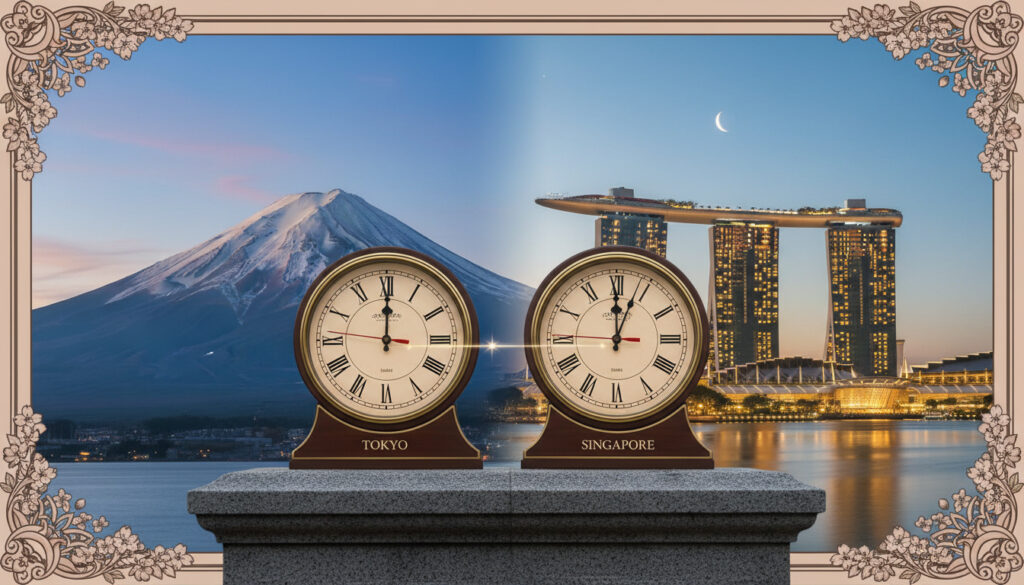
Japan Time to Singapore Time – Fixed 1-Hour Difference
Japan Standard Time runs exactly one hour ahead of Singapore Time throughout the year. This fixed offset creates a predictable relationship between the two Asian financial centers, eliminating the confusion of seasonal clock changes.
Whether scheduling international business calls between Tokyo and Singapore or coordinating travel plans, understanding this consistent sixty-minute gap simplifies cross-border coordination. Both nations maintain standard time zones that have remained unchanged for decades.
Unlike regions that observe daylight saving time, Japan and Singapore use fixed UTC offsets year-round. Japan operates under Japan Standard Time (JST) at UTC+9, while Singapore follows Singapore Time (SGT) at UTC+8, creating a permanent time difference that never fluctuates.
What is the Time Difference Between Japan and Singapore?
The time difference between Japan and Singapore stands at exactly one hour, with Japan consistently ahead. This relationship remains static regardless of the season, as neither country adjusts their clocks for daylight saving time.
Key facts about the Japan-Singapore time relationship:
- The gap remains fixed at 60 minutes throughout the calendar year
- Japan Standard Time uses a UTC+9 offset nationwide, covering Tokyo, Osaka, and Sapporo
- Singapore Time maintains a UTC+8 offset across the entire city-state
- No clock adjustments are required when traveling between the two countries
- The difference aligns with standard business hours in both locations
- Converting between zones requires only simple addition or subtraction
- Both time zones reference distinct geographic meridians
| Location | Time Zone | UTC Offset | Example Local Time |
|---|---|---|---|
| Japan | JST | UTC+9 | 9:00 AM View converter |
| Singapore | SGT | UTC+8 | 8:00 AM |
| Japan | JST | UTC+9 | 12:00 PM |
| Singapore | SGT | UTC+8 | 11:00 AM |
| Japan | JST | UTC+9 | 3:00 PM |
| Singapore | SGT | UTC+8 | 2:00 PM |
| Japan | JST | UTC+9 | 5:00 PM |
| Singapore | SGT | UTC+8 | 4:00 PM Check current time |
| Japan | JST | UTC+9 | 11:00 PM |
| Singapore | SGT | UTC+8 | 10:00 PM |
Current Japan Time in Singapore
When determining the current time across both locations, Singapore local time always trails Japan by exactly sixty minutes. If it is 3:00 PM in Tokyo, clocks in Singapore display 2:00 PM.
Real-Time Conversion Logic
To find the current Japan time when knowing Singapore time, add one hour to the local Singapore time. Conversely, subtract one hour from Japan time to determine the corresponding moment in Singapore. Online conversion tools automate this calculation by referencing the fixed UTC offsets.
Optimal Communication Windows
Business operations benefit from substantial overlapping hours. The period between 9:00 AM and 6:00 PM in Japan corresponds to 8:00 AM through 5:00 PM in Singapore, creating a nine-hour window for synchronous communication.
Schedule video conferences between 10:00 AM and 5:00 PM Japan Standard Time. This translates to 9:00 AM through 4:00 PM Singapore Time, ensuring participants in both locations remain within standard business hours without requiring early morning or evening availability.
How to Convert Japan Time to Singapore Time
Converting between Japan Standard Time and Singapore Time requires basic arithmetic or digital assistance. The process remains consistent year-round due to the absence of daylight saving adjustments.
Manual Calculation Methods
For mental conversion, remember that Singapore operates one hour behind Japan. When converting JST to SGT, subtract one hour from the Japan time. When converting SGT to JST, add one hour to the Singapore time. Converter tools verify these calculations instantly.
Digital Converter Applications
Multiple online platforms provide real-time conversion displays. These tools reference the standard UTC+9 and UTC+8 offsets to generate accurate readings without requiring manual computation.
Memorize the phrase “Japan is one hour ahead.” When a colleague in Tokyo suggests a 2:00 PM meeting, immediately recognize this as 1:00 PM your time if you are in Singapore. The relationship never changes, making long-term planning straightforward.
Do Japan or Singapore Observe Daylight Saving Time?
Neither Japan nor Singapore observes daylight saving time. Both locations maintain their standard time offsets permanently throughout the year, eliminating the biannual clock changes experienced in Europe and North America.
Japan’s Historical DST Usage
Japan briefly observed daylight saving time between 1948 and 1951 during the post-war occupation period. However, the practice ended in 1951, and Japan has maintained a fixed UTC+9 offset nationwide since then.
Singapore’s Permanent Standard Time
Singapore has never implemented daylight saving time. The city-state adopted its current UTC+8 offset in 1905 and has maintained this standard continuously. Time difference calculators confirm this stability requires no seasonal adjustments.
Travelers and schedulers can rely on the fixed one-hour difference without checking seasonal variations. Unlike transatlantic routes where time differences shift by an hour twice yearly, the Japan-Singapore relationship remains constant every day of the year.
History of Time Standards in East Asia
The current time relationship between Japan and Singapore results from distinct historical adoptions of standard time during the late nineteenth and early twentieth centuries.
- 1880s: Japan adopts UTC+9 based on the 135 degrees East meridian passing through Akashi, establishing Japan Standard Time nationwide.
- 1905: Singapore adopts UTC+8, aligning with the 112 degrees East meridian standard, creating the one-hour differential with Japan.
- 1948: Japan temporarily introduces daylight saving time during the Allied occupation to conserve resources.
- 1951: Japan permanently abolishes daylight saving time, returning to fixed UTC+9 year-round.
- Present: Both nations maintain their respective offsets with no scheduled changes to time policy.
Sources confirm that time zone databases reflect this historical stability in their current configurations.
Established Facts and Information Gaps
While the basic time relationship is well-documented through multiple converter platforms, certain official documentation remains absent from publicly available sources. The fixed one-hour difference between Japan and Singapore is explained at singaporejournal.com. singaporejournal.com
| Established Information | Uncertain or Unverified Details |
|---|---|
| Japan is exactly 1 hour ahead of Singapore | Official government policy statements from Japanese ministries |
| JST uses UTC+9 nationwide | Singapore government portal documentation on time standards |
| SGT uses UTC+8 citywide | Historical records prior to 1905 in Singapore |
| Neither observes DST | Future policy change announcements |
| Japan abolished DST in 1951 | Official rationale for Singapore never adopting DST |
No official government sources from Japan’s National Institute of Information and Communications Technology or Singapore government portals appeared in available results, though all converters align on the fixed offsets.
Why the One-Hour Difference Exists
Geographic positioning determines the time separation between these Asian nations. Japan lies approximately 15 degrees longitude east of Singapore, corresponding to one hour of solar time difference based on Earth’s rotation.
Standard time zones typically vary by one hour per 15 degrees of longitude. Japan’s standard meridian runs through Akashi at 135°E, while Singapore references approximately 112°E. This 23-degree separation falls within the standard zone widths, with Japan occupying the UTC+9 zone and Singapore the UTC+8 zone. Geographic time references confirm this alignment.
Both nations chose their respective offsets to approximate mean solar time for their longitudes while maintaining consistency with neighboring regions. This standardization facilitates trade and communication while acknowledging natural geographic differences.
Sources and Verification
Time zone data for this analysis derives from multiple converter platforms and geographic databases. While official government sources were not directly accessible, consensus across independent time services confirms the fixed relationship.
Japan Standard Time is always 1 hour ahead of Singapore Time. JST uses a fixed UTC+9 offset, while SGT uses a fixed UTC+8 offset, resulting in a consistent year-round difference with no variations.
Aggregated converter data from multiple time zone services
Additional verification comes from UTC conversion references and international time zone databases maintained by IANA.
Key Takeaways on Japan and Singapore Time
The Japan-Singapore time relationship offers rare simplicity in international scheduling. The fixed one-hour difference requires no seasonal adjustments, making long-term planning reliable for businesses and travelers. Remember that Japan always leads by sixty minutes, and neither nation changes their clocks throughout the year. For currency context when planning trips, check the 1500 USD to SGD – Live Rate Chart and Trends to understand exchange rate movements alongside your timing considerations.
Frequently Asked Questions
Is Japan always exactly one hour ahead of Singapore?
Yes. The time difference remains fixed at 60 minutes year-round because neither country observes daylight saving time. Japan Standard Time at UTC+9 consistently leads Singapore Time at UTC+8.
What is the best time for video calls between Tokyo and Singapore?
Schedule calls between 9:00 AM and 5:00 PM Singapore Time, which corresponds to 10:00 AM to 6:00 PM in Tokyo. This window keeps both parties within standard business hours.
Does Singapore change clocks for daylight saving?
No. Singapore has never observed daylight saving time. The country maintains UTC+8 continuously throughout the year without seasonal adjustments.
How do I quickly convert Japan time to Singapore time mentally?
Subtract one hour from any Japan time to get Singapore time. For example, 3:00 PM in Tokyo equals 2:00 PM in Singapore. The calculation never changes.
Do flight schedules between Japan and Singapore account for the time difference?
Yes. Airlines publish arrival and departure times in local time zones. A flight departing Tokyo at 11:00 AM arrives in Singapore at approximately 5:00 PM Singapore Time, reflecting the one-hour time shift plus flight duration.
Will Japan or Singapore change their time zones in the future?
No official announcements suggest changes to either time zone. Both nations have maintained their current UTC offsets for decades with no indications of policy revisions.
Do both countries use the 24-hour clock format?
Both nations commonly use both 12-hour and 24-hour formats. Japan frequently uses 24-hour notation in transportation and official contexts, while Singapore uses both systems interchangeably depending on context.
Where can I find live currency rates for Singapore?
For travelers coordinating payments across time zones, see 10 Dolar Singapura Berapa Rupiah – Live Rates and Conversion Tips for current exchange information.
More related posts
 Best Arepa de Choclo Near Me: Top Tripadvisor Spots
 Singapore Airlines Departure Terminal at Changi
 Thomson-East Coast Line Map: Route, Stations & Stages
 ANDES by ASTONS Menu: Prices, Side Dishes & Halal Info
 The Haunted Palace (TV Series) – Plot, Cast, Ratings Guide
 5’8″ in cm: Exact Conversion & Height Context
 Be t Pork Crackling with Apple Sauce Near Me: Tip & Local Find
 First Resources Share Price – Latest Price, Chart & Analysis