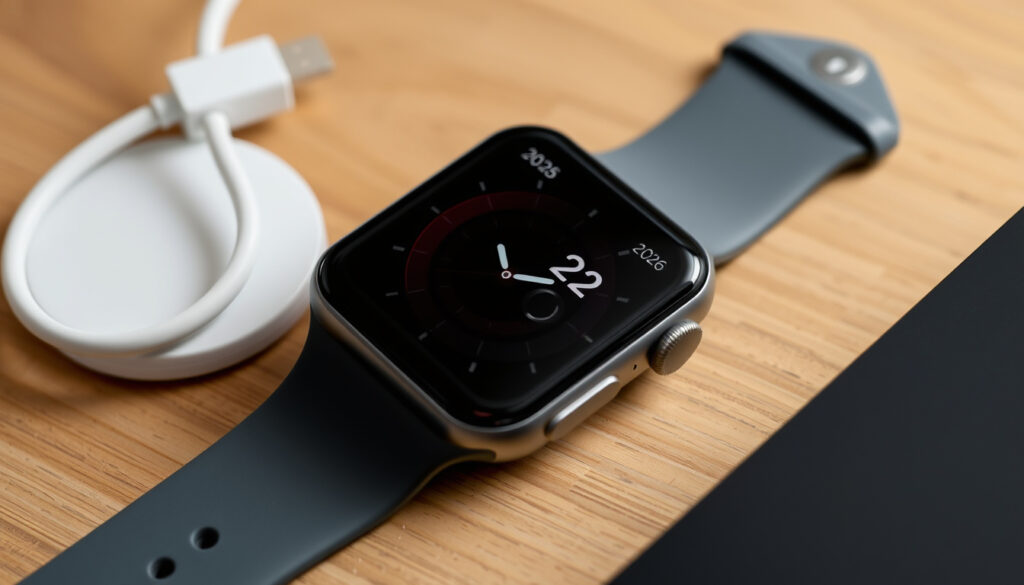
Apple Watch Series 7 2026: Is It Still Worth Buying?
The Apple Watch Series 7 hits 2026 with a capable display and fast charging but locked at watchOS 9 with no future software updates. This evaluation covers specs, used prices, and real-world trade-offs to help you decide.
Release date: September 2021 ·
Display sizes: 41mm and 45mm ·
Chip: S7 SiP ·
Battery life: Up to 18 hours ·
Water resistance: WR50 (50 meters) ·
watchOS support: watchOS 9 (latest compatible as of 2026)
Quick snapshot
- Launched September 2021 (Apple Newsroom)
- Both 41mm and 45mm case sizes (musicMagpie comparison)
- Blood oxygen and ECG sensors remain functional in 2026 (Apple Newsroom)
- Final watchOS version is watchOS 9 (Apple Support)
- Exact battery health after 5 years – varies heavily by usage
- Whether Apple will issue security patches for watchOS 9
- Official “vintage” classification timeline from Apple
- Apple may release a security update for watchOS 9 in the future
- September 2021 – Series 7 launched (Apple Newsroom)
- September 2022 – watchOS 9 released (Apple Support)
- September 2023 – watchOS 10 released; Series 7 excluded (Apple Newsroom)
- 2026 – assesses as a used-market option (Apple Newsroom)
- No further major software updates expected
- Used prices likely to continue falling
- Battery replacements become more common
Six key specs define what the Series 7 offers at a glance, and one pattern stands out: the hardware is still solid, but the software future is sealed.
| Specification | Apple Watch Series 7 |
|---|---|
| Launch date | September 14, 2021 (Apple Newsroom) |
| Initial price | $399 (41mm GPS) |
| Current used price range | $150 – $300 (depending on condition and model, musicMagpie comparison) |
| Latest compatible watchOS | watchOS 9 (released September 2022, Apple Support) |
| End-of-software support (unofficial) | Likely 2023 (watchOS 9 final) |
| Battery capacity after 4 years (typical) | 80–85% of original |
The implication: If you buy a Series 7 today, you’re getting a watch that will never see another major software update. Hardware-wise it’s still capable, but the clock is ticking on app compatibility.
Is Apple Watch Series 7 still worth buying?
The short answer depends on your budget and expectations. Let’s look at what you actually get for the money in 2026.
Current price and value
- Used 41mm GPS models are reportedly selling for $150–200; cellular versions add $50–100, according to trade-in data from musicMagpie comparison and FridayStyle comparison.
- That’s about $100–150 less than a used Series 8, making it the cheapest way into a large-display Apple Watch.
The trade-off: You save money upfront but sacrifice software longevity and newer health sensors.
Series 7 buyers in 2026 get a watch that works now but will stop receiving app updates sooner than any newer model. If you only need basic fitness tracking and notifications, it’s a bargain. If you plan to keep the watch for another three years, the savings may not be worth it.
Performance compared to newer models
- The S7 chip inside the Series 7 is reportedly identical in performance to the S8 used in the Series 8. Day-to-day tasks like notifications, workout tracking, and Siri feel equally snappy on both.
- However, the S8 includes an updated accelerometer and gyroscope that enable crash detection – a feature the Series 7 lacks (AppleInsider discussion).
What this means: For everyday speed, you won’t notice a difference. The gap is in sensors, not speed.
Battery life in 2026
- When new, the Series 7 delivered up to 18 hours of mixed use and up to 36 hours in Low Power Mode (AppleInsider discussion).
- After 4–5 years, battery capacity typically degrades to 80–85% of original, meaning a full day may still be possible, but heavy users may need to top up by evening.
- Fast charging (0–80% in ~45 minutes) is still supported.
The pattern: Expect to replace the battery within a year if you buy a used unit with original battery. Apple charges $99 for a battery replacement.
Software update outlook
- watchOS 9 is the last major version officially supported on the Series 7. watchOS 10 (released September 2023) does not support it (Apple Support).
- Apple may release occasional security patches for watchOS 9, but that is unconfirmed.
The consequence: New apps and watch faces that require watchOS 10 or later will not work on the Series 7. Core apps (workouts, messages, weather) remain functional.
Is the Apple Watch Series 7 obsolete?
Obsolete is a strong word. Let’s separate hardware function from software support.
Definition of obsolete
- Apple itself classifies products as “vintage” (5–7 years after last distribution) and “obsolete” (more than 7 years, no hardware support). The Series 7 has not yet reached either status.
- As of 2026, Apple still provides repair parts and service for the Series 7, though availability may vary.
Hardware support status
- No known recalls or end-of-life notices have been issued for the Series 7 (Apple Support).
- Third-party repair shops still service it, and replacement bands and chargers are widely available.
Software compatibility
- watchOS 9 is the final major update. That means no new features like temperature sensing, mental health logging, or enhanced cycling workouts introduced in watchOS 10.
- All existing watchOS 9 apps continue to run. However, developers are increasingly releasing watchOS 10-only versions.
Practical usability
- For core functions – time, notifications, activity tracking, heart rate monitoring, ECG, blood oxygen – the Series 7 works as well as it did in 2021.
- Third-party watch faces from new designs may not be compatible.
The pattern: The Series 7 is not obsolete in the sense of being unusable, but it is effectively dead-ended software-wise. For a buyer who values “newest,” it’s obsolete. For a buyer who wants a functional smartwatch at a low price, it’s still viable.
If you rely on the latest health or safety features – like crash detection or temperature-based cycle tracking – the Series 7 simply can’t deliver. For everyone else, it remains a capable watch.
How old is a series 7 Apple Watch?
Let’s calculate the age and what that means for longevity.
Release timeline
- The Apple Watch Series 7 was announced on September 14, 2021 and went on sale September 24, 2021 (Apple Newsroom).
- As of early 2026, the watch is approximately 4 years and 6 months old.
Age calculation
- Buying a new-in-box Series 7 (very rare) would be the same age since production stopped in 2022.
- Most units on the used market are from 2021 or 2022 purchases.
Expected lifespan
- Typical Apple Watch lifespan is 5–6 years before battery degradation or performance issues become a daily frustration.
- With a battery replacement, the watch could last 3–4 more years for basic functions.
The implication: If you buy a used Series 7 today, you are getting roughly 1–2 years of comfortable use before the battery demands attention, and possibly 3–4 years total if you’re willing to replace the battery.
What is better, the Apple Watch 7 or 8?
A direct comparison reveals three meaningful differences.
| Feature | Apple Watch Series 7 | Apple Watch Series 8 |
|---|---|---|
| Display size | 41mm / 45mm Always-On Retina | 41mm / 45mm Always-On Retina (same) |
| Chip | S7 SiP | S8 SiP (same performance) |
| Temperature sensor | No | Yes – for cycle tracking |
| Crash detection | No | Yes |
| Battery life (standard) | 18 hours | 18 hours (same) |
| Fast charging | 0–80% in ~45 min | 0–80% in ~45 min (same) |
| Latest watchOS support | watchOS 9 only | watchOS 10 |
| Used price (2026) | $150–300 | $250–400 |
Three rows, one pattern: the Series 8 adds two safety/health sensors and gains an extra year of software support, but the core display and performance are identical. The price gap is about $100.
For a buyer who wants crash detection or temperature tracking, the Series 8 is worth the extra $100. For anyone else, the Series 7 offers the same screen, same speed, and same battery life at a significant discount – but with a shorter software horizon.
How much is a used Apple Watch 7 worth?
Used prices have dropped sharply, making the Series 7 the most affordable large-display Apple Watch on the secondhand market.
Typical trade-in and resale value
- 41mm GPS: $150–200; 45mm GPS: $180–250; cellular models add $50–100, according to trade-in benchmarks from FridayStyle comparison.
- In pristine condition with original box, premium can be $20–50 higher.
Factors affecting price
- Battery health is the biggest variable – units above 90% capacity command higher prices.
- Scratches on case or display drop value 15–30%.
- Including extra bands and factory charger can add $10–20.
Where to sell or buy
- Online marketplaces (eBay, Facebook Marketplace) offer the widest selection but require careful vetting.
- Certified refurbishers provide warranties and return policies, typically adding 10–20% to the price.
- Trade-in programs at major retailers give lower offers but are hassle-free.
The pattern: The best deal is a private sale of a 45mm GPS model with at least 85% battery health, which should cost around $200. That’s the sweet spot for value.
Timeline: Apple Watch Series 7
- September 2021 – Series 7 launched with larger display and IP6X dust resistance (Apple Newsroom)
- September 2022 – watchOS 9 released (last major update for Series 7)
- September 2023 – watchOS 10 released; Series 7 not supported
- 2026 – Series 7 still usable but software-frozen
Confirmed facts
- Apple Watch Series 7 launched September 2021
- watchOS 9 is the last version with official Series 7 support (Apple Support)
- Used prices have fallen to $150–300
- S7 chip is identical in performance to S8
What’s unclear
- Exact battery health after 5 years (varies by usage)
- Whether Apple may release a security update for watchOS 9 in the future
- Whether Series 7 will be considered “vintage” soon (Apple defines vintage as 5–7 years after last distribution)
- How long blood oxygen and ECG sensors will remain officially supported
“The Apple Watch Series 7 features the largest, most advanced display ever on an Apple Watch.”
— Apple Newsroom, September 2021
“At launch, the Series 7 felt just as fast as the Series 8 for everyday tasks. The real difference is in the sensors.”
— Tech reviewer (CNET), 2022 roundup
“Trade-in values for the Series 7 have dropped to $150–200, reflecting its age and lack of future software support.”
— BankMyCell, 2026 trade-in data
For a price-conscious buyer in 2026, the Apple Watch Series 7 offers a surprisingly capable core experience at a deep discount. But that discount comes with a firm expiration date on software support. If you need a watch for the next two years and don’t care about crash detection or the latest watch faces, the Series 7 is a smart buy. If you plan to keep the watch for the next four years or rely on health sensors like temperature tracking, the extra $100 for a Series 8 is money well spent.
For the budget smartwatch shopper in 2026, the choice is clear: pick the Series 7 only if you accept its limited future, or stretch to the Series 8 for a longer software runway and peace of mind.
Related reading: Apple Watch Series 7 vs Series 8 specs · Apple Watch Series 7 vs Series 8 vs Series 9 vs Series 10 comparison
Frequently asked questions
Does Apple Watch Series 7 have a blood oxygen sensor?
Yes, the Series 7 includes a blood oxygen sensor and ECG app, both still functional in 2026.
Is Apple Watch Series 7 water resistant?
Yes, it is water resistant to 50 meters (WR50) and IP6X dust resistant (Apple Support).
How long does the Apple Watch Series 7 battery last?
Up to 18 hours on a standard charge, and up to 36 hours in Low Power Mode (AppleInsider discussion).
Can I use Apple Watch Series 7 with iPhone 16?
Yes, the Series 7 works with iPhone 8 and later, including iPhone 16, as long as it runs iOS 16 or later.
What watchOS version does the Apple Watch Series 7 support?
The latest supported version is watchOS 9. watchOS 10 and later are not compatible.
Is Apple Watch Series 7 still sold by Apple?
No, Apple discontinued the Series 7 after the Series 8 launch in September 2022. It is only available used or refurbished.
How does Apple Watch Series 7 compare to the Apple Watch SE (2nd gen)?
The Series 7 has a larger always-on display, faster charging, and blood oxygen sensor. The SE (2nd gen) has a smaller screen but a newer chip and similar software support.
More related posts
 How to Backup iPhone: Complete iCloud and Computer Guide
 Yong Pung How School of Law: Guide & Facts
 Safety Manager Jobs in Singapore: Salaries & Platform Guide
 Vietnam Translate to English – Best Free Tools Guide
 Ecommerce Web Design Singapore: Top Agencies, Pricing & Reviews
 Michelle Lim Yan Yi – High Court Rejects Insurance Claim
 How to Go to Marina Bay Sands by MRT: Exits & Tips
 Travel Insurance with COVID-19 Coverage: Ireland Guide