API 607 vs API 608: Fire Test vs Ball Valve Standard
When you’re specifying valves for hydrocarbon or chemical service, one decision keeps engineers up at night: fire safety compliance. API 607 and API 608 serve completely different roles — API 607 tests fire containment at 704°C, while API 608 sets design rules for metal ball valves — and mixing them up means either overpaying for unused certification or missing a safety requirement.
API 607 fire test temperature: 704°C (1300°F) ·
API 608 pressure class: Up to Class 300 ·
API 607 test duration: 30 minutes ·
API 608 latest edition: 2020
Quick snapshot
- API 607 is a fire test standard for soft-seated quarter-turn valves (Intertek Inform, standards certification body)
- API 608 is a ball valve product standard covering design, materials and testing (Dombor Valve, industrial valve manufacturer)
- API 607 test exposes valves to 704°C for 30 minutes (Bray International, fire-safe valve whitepaper)
- Exact cost difference between API 607 and API 608 valves is not standardized
- Whether API 608 requires API 607 certification for all ball valves is not mandatory
- Whether API 608 strictly limits ball valves to sizes 1/4” to 4” and Class 150/300, or if manufacturers apply the standard more broadly
- API 607 edition: 7th (2016), with API STD 607:2022 also published (Intertek Inform, standards certification body)
- Latest API 608 edition: 4th (2020) (Valves Supplier, industrial valve industry resource)
- Engineers must decide if fire certification (API 607) is required in addition to API 608
- Purchase specifications increasingly demand both standards for critical service
Five key facts, one pattern: API 607 and API 608 address completely different aspects of valve performance — fire safety versus normal operation.
| Attribute | API 607 | API 608 |
|---|---|---|
| Standard Type | Fire test | Ball valve product |
| Valve Type | Soft-seated quarter-turn | Metal-seated ball |
| Pressure Class | Not specified | Class 150, 300 |
| Size Range | Not limited | 1/4” to 4” |
| Latest Edition | 7th (2016) | 4th (2020) |
| Fire Test Requirement | Mandatory (in standard) | Not required (unless specified) |
| Leakage Criteria (Post-Fire) | External ≤0.1 in³/min, Internal ≤0.5 in³/min | Not specified |
| Primary Focus | Fire survival and containment | Normal operation reliability |
What is the difference between API 607 and 608?
API 607: Fire Test Standard
- API 607 defines a fire type-testing method for quarter-turn valves with nonmetallic seating (Eagle Fittings, industrial valve components supplier).
- It is not a valve design standard — it measures leakage control and structural integrity during and after fire exposure.
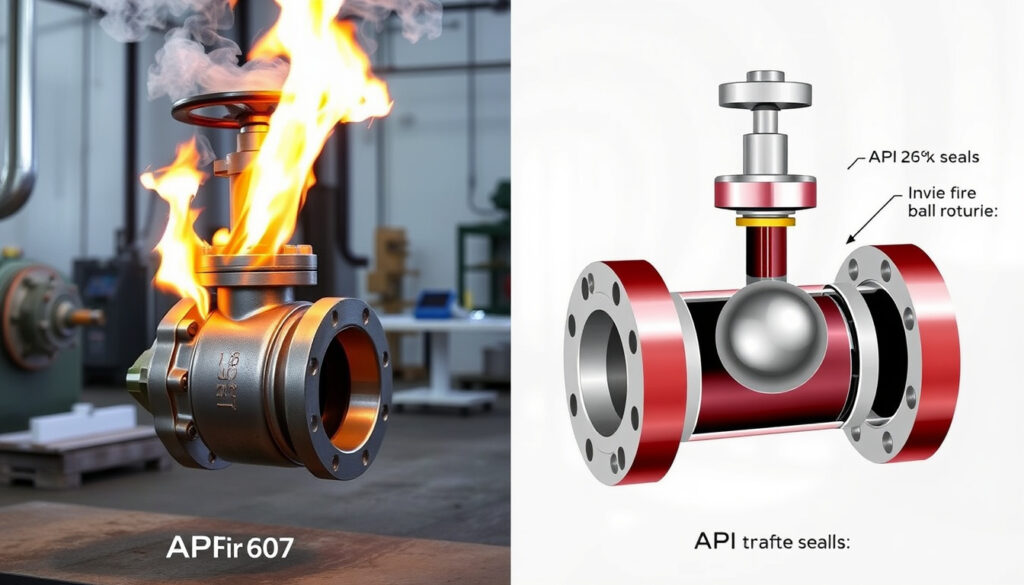
- The test exposes the closed valve to a sustained fire at 704°C (1300°F) for 30 minutes while pressurized.
API 608: Ball Valve Product Standard
- API 608 is a design and manufacturing standard for metal ball valves, covering construction, materials, dimensions, and performance under normal service conditions.
- It applies to floating and fixed-ball designs in sizes 1/4” to 4” for Class 150 and 300.
- API 608 does not mandate fire certification as a baseline requirement — buyers must specify API 607 separately (Lixin Valve Group, valve manufacturer).
Key Differences at a Glance
One standard tests fire survival, the other ensures daily reliability. The trade-off: if you specify API 608 alone, you get a well-built ball valve but no guarantee it will contain pressure under fire. Adding API 607 certification increases cost but is essential for hydrocarbon and chemical applications where post-fire leakage is unacceptable.
The pattern is clear: one standard validates survival under extreme conditions, the other governs everyday performance. Engineers specifying valves for hazardous services should treat them as complementary requirements, not alternatives.
What is API 608 used for?
API 608 Ball Valve Applications
- API 608 ball valves are widely used in oil and gas, chemical processing, and industrial piping systems where reliable shut-off at moderate pressures is needed.
- Common applications include process lines, utility services, and skid-mounted systems.
Pressure Classes and Materials
- The standard covers Class 150 and Class 300 pressure ratings.
- Materials typically include carbon steel, stainless steel, and alloy bodies with metal or polymer seats.
API 608 vs API 6D
- API 608 covers smaller ball valves (1/4” to 4”), while API 6D applies to larger pipeline valves.
The implication: API 608 is the go-to standard for compact, moderate-pressure ball valves, while API 6D handles large pipeline valves. Specifiers should match the standard to valve size and service.
What does API 607 mean?
API 607 Fire Test Procedure
- The valve is installed in a test rig, closed, pressurized with water, and exposed to a controlled fire that raises the body temperature to at least 650°C.
- The fire burns for 30 minutes, and the valve is then allowed to cool naturally.
Criteria for Passing
- External leakage must not exceed 0.1 in³/min during the test.
- Internal leakage (past the seat) must not exceed 0.5 in³/min after the fire (Tango Valve, fire-safe valve specialist).
Soft-Seated Valve Focus
- API 607 was specifically developed for quarter-turn valves with nonmetallic seats, which are vulnerable to melting or deformation in a fire (NSW Valve, valve testing resource).
Soft seats that pass API 607 still rely on metal-to-metal backup sealing after the soft seat is destroyed. Engineers should verify the secondary sealing design, not just the test certificate.
The implication: passing API 607 requires more than just a soft seat — the valve must have a robust secondary metal-to-metal sealing mechanism. Procurement specifications should demand evidence of this design, not just a certificate.
Does API 607 apply to check valves?
Scope of API 607
- API 607 is specifically for quarter-turn valves: ball, plug, and butterfly valves.
- Check valves are not quarter-turn and therefore not covered by API 607.
Check Valve Fire Testing Standards
- For check valves, the applicable fire test standard is API 6FA (fire test for valves).
- API 6FA covers a broader range of valve types including gate, globe, and check valves.
What this means: if you need a fire-certified check valve, look for API 6FA compliance, not API 607. Specifying the wrong standard can lead to false certification claims.
What is API 607 spec?
API 607 Specification Details
- API 607 specifies the fire test method, including test setup, temperature measurement (thermocouples), pressure conditions, and acceptance criteria.
- The standard also covers test report requirements and certification documentation.
Testing Requirements
- The valve must be tested in the closed position with internal pressure.
- Fire temperature is maintained at 704°C (1300°F) for 30 minutes.
- After the fire, a cooling period is followed by a pressure test to measure leakage.
Certification
- Valves that pass are certified as fire-safe and can carry an API 607 monogram (if the manufacturer holds an API license).
- Some manufacturers reportedly report a higher test temperature of 816°C (1500°F) under API 607 7th edition, but this is not consistently documented across sources (ZFA Valve, industry blog — lower confidence).
The takeaway: API 607 certification adds significant cost but is non-negotiable for hydrocarbon and chemical processing applications where post-fire containment is critical.
“API 607 belongs against the fire-test evidence, while API 608 belongs against the supplied ball valve’s product requirements.”
— Tango Valve (fire-safe valve specialist)
“For API 607, the focus is on fire-testing procedures, while API 608 emphasizes general performance standards.”
— One Ro Valve (valve manufacturer)
“Unlike API 607, which covers soft-seated valves, API 608 covers metal-seated valves.”
— NSW Valve (valve testing resource)
Three industry voices, one consensus: the two standards complement each other — API 607 proves fire safety, API 608 proves everyday reliability. For critical hydrocarbon service, both are non-negotiable.
The implication for engineers: specifying API 608 without API 607 is common practice for non-critical lines, but in refineries and chemical plants, the fire-safe requirement is increasingly written into purchase orders. The cost delta — typically 20–30% premium for 607-certified valves — is small compared to the liability of a post-fire leak. For procurement teams in the oil and gas sector, the choice is clear: when in doubt, specify both, or accept the risk of a fire that your valve wasn’t designed to survive.
Frequently asked questions
What is the difference between API 607 and API 6FA?
API 607 applies to quarter-turn valves (ball, plug, butterfly); API 6FA covers all valve types including gate, globe, check, and ball valves for fire testing.
Can a ball valve be API 607 certified without being API 608 compliant?
Yes, a valve can be fire-tested to API 607 without meeting API 608’s design requirements, but most purchasers require both for ball valves in critical service.
What is the API 608 standard for ball valve materials?
API 608 covers materials such as carbon steel, stainless steel, and alloys, with requirements for pressure-temperature ratings, dimensions, and testing.
How long does an API 607 fire test take?
The fire exposure lasts 30 minutes, plus setup, burn, cooling, and pressure testing — typically 2–4 hours total per valve.
Is API 608 required for fire-safe ball valves?
No, API 608 itself does not mandate fire safety. Fire-safe ball valves need API 607 certification in addition to API 608 design compliance.
What are the common materials used in API 608 ball valves?
Common materials include ASTM A216 WCB carbon steel, ASTM A351 CF8M stainless steel, and various alloy steels for trim and seats.
Does API 607 apply to butterfly valves?
Yes, API 607 applies to quarter-turn valves including butterfly valves with nonmetallic seating.
Where can I buy API 607 certified valves?
Major manufacturers such as Cameron, Flowserve, and Velan offer API 607-certified valves. Check the manufacturer’s certification scope.