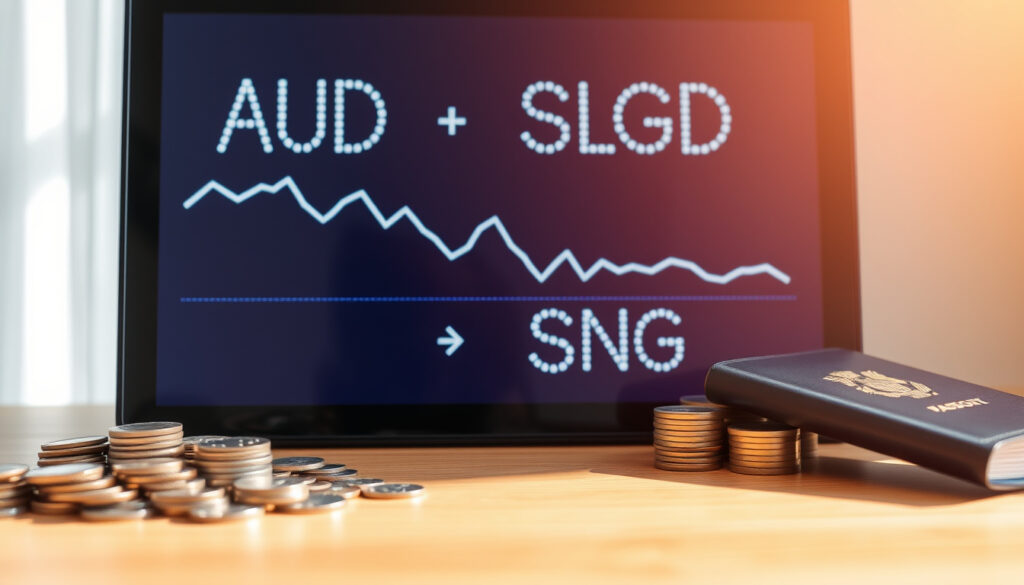
Convert AUD to SGD: Best Rates, Forecast & Tips
Planning a trip to Singapore or sending money there? The AUD to SGD rate can make a big difference to your budget, with one Australian dollar currently buying about 0.916 Singapore dollars — a rate that shifts constantly.
Current mid-market rate: 1 AUD = 0.9161 SGD ·
100 AUD to SGD: 91.61 SGD ·
1,000 AUD to SGD: 916.10 SGD
Quick snapshot
- 1 AUD ≈ 0.9161 SGD at mid-market (based on data from OFX and Gov.Capital)
- AUD has weakened about 2% over six months (Trading Economics)
- Online providers like Wise and Revolut offer rates close to mid-market (OFX live rate data)
- Whether the AUD will strengthen or weaken further in 2026
- Exact impact of future RBA interest rate decisions on the AUD/SGD pair
- How long current rate trends will persist
- Jan 2025: rate near 0.9350 (Trading Economics)
- Mid-2025: dip to 0.9080 after RBA decision (OCBC)
- Late 2025: recovery to 0.9161 (OFX live rate data)
- 2026 forecast range: 0.88 – 0.94 (Longforecast)
- Market analysts expect moderate AUD weakness through 2026
- Online transfers likely to remain cheapest method
- Monitor RBA and MAS policy announcements
One pattern stands out among the core facts: the rate has moved inside a 3¢ range over the past year, but forecasts diverge sharply depending on the model.
| Fact | Value |
|---|---|
| Currency pair | AUD/SGD |
| Current rate (mid-market) | 1 AUD = 0.9161 SGD |
| 100 AUD in SGD | 91.61 SGD |
| Recent trend (6 months) | AUD has weakened approximately 2% |
Why is AUD falling against SGD?
Current factors weakening the AUD
- The interest rate differential between the Reserve Bank of Australia and the Monetary Authority of Singapore has narrowed, reducing the carry appeal of the Australian dollar. OCBC noted an upward normalisation in SGD interest rates that happened faster than expected.
- Falling commodity prices – especially iron ore and coal – have historically weighed on the Aussie. The Australian dollar is highly correlated with commodity exports. Standard Chartered Singapore lists commodity prices as a key driver.
- Market risk appetite shifts: when global uncertainty rises, investors favour the safe-haven Singapore dollar over the growth-linked AUD. The same Standard Chartered Singapore analysis includes geopolitical events among the factors.
Expert forecast for 2026
Forecasters are split. MUFG Research projects the AUD against the USD at 0.6687 by end-2025, rising to 0.7100 by Q4 2026, while the SGD is forecast at 1.2851 per USD end-2025 and 1.2750 by Q4 2026. Those cross-rate paths imply an AUD/SGD range roughly between 0.88 and 0.94. Trading Economics expects the SGD/AUD rate to end the quarter at 1.18698 (AUD/SGD ≈ 0.8425). Meanwhile, Longforecast predicts AUD/SGD at 0.875 by April 2026 and 0.923 by August 2026. CoinCodex sees a 2026 range of 1.01–1.09 SGD per AUD (i.e., 0.92–0.99 AUD/SGD). The wide spread reflects genuine uncertainty.
Forecasts from different models diverge by as much as 15 cents on the AUD/SGD rate for 2026. Relying on a single prediction is risky; plan for a band rather than a point estimate.
Impact on travelers and businesses
- Travelers converting AUD to SGD now get fewer Singapore dollars than they would have a year ago.
- Businesses with regular SGD exposures face higher hedging costs.
- Remittance volumes to Singapore may shift if the rate continues falling.
What is a good exchange rate for AUD to SGD?
Mid-market rate vs. cash rate
The mid-market rate – the wholesale rate banks use among themselves – is the fairest benchmark. Right now that’s about 0.9161. But most consumers never get that rate. Cash exchange counters at airports or hotels typically add a 3–5% markup. Standard Chartered Singapore advises comparing total costs, not just the headline rate.
How to spot a favorable rate
- Compare the offered rate to the current mid-market. Anything within 1% is competitive.
- Check whether the spread (difference between buy and sell) is narrower than 2%.
- Use online comparator tools that show real-time rates from multiple providers.
Typical spreads for different transfer methods
Three common methods, one clear pattern: online specialists are cheapest.
| Method | Typical markup vs mid-market | Example cost on 1,000 AUD |
|---|---|---|
| Bank transfer (wire) | 3–5% | A$30–50 |
| Airport cash exchange | 5–8% | A$50–80 |
| Online provider (Wise, Revolut) | 0.5–1.5% | A$5–15 |
The pattern is clear: online specialists consistently deliver rates far closer to the mid-market than traditional banks or airport counters.
Why this matters: for a typical overseas transfer of A$5,000, choosing an online provider over a bank can save A$100–200.
Is it better to change SGD to AUD in Singapore or Australia?
Exchange rates in Singapore vs. Australia
In Australia, banks and money changers often include higher overheads. In Singapore, licensed money changers at places like The Arcade or Lucky Plaza are known for competitive cash rates. Standard Chartered Singapore notes that rate shopping inside Singapore can yield significantly better deals.
Fees and commissions comparison
- Australian banks: typical fee of A$10–20 plus a 3% margin on the rate.
- Singapore money changers: no fee, but the rate includes a 2–4% margin.
- Online transfer: low fee (A$0–5) plus margin under 1%.
Convenience and accessibility for travelers
If you’re already in Singapore, changing SGD to AUD at a reputable money changer is convenient and cost-effective. For larger amounts, an online transfer to your Australian bank account before you travel often beats both cash methods.
The trade-off: cash gives you instant access, but online transfers yield better net amounts for sums above A$500.
Which country is cheaper, Singapore or Australia?
Cost of living overview
Singapore generally has higher housing costs – especially for rentals – but lower personal income taxes. Australia offers higher wages in many sectors but also higher costs for food, utilities, and transport in major cities like Sydney and Melbourne. OCBC data underscores that exchange rate movements directly affect cross-border purchasing power.
Salary benchmarks in each country
- Median full-time salary in Australia: about A$80,000 per year.
- Median salary in Singapore: around S$60,000 per year (gross).
- At the current rate, A$80,000 converts to about S$73,300 – lower than the Singapore median after conversion.
How exchange rate affects purchasing power
A weakening AUD means Australians find Singapore more expensive when converting. Conversely, Singaporeans earning in SGD see their Australian travel budget stretch further. The recent 2% drop in AUD against SGD since mid-2025 already reduces real spending power by roughly that amount for visitors to Singapore.
The pattern: the exchange rate amplifies salary differences; at current levels, an Australian moving to Singapore would need a significant salary bump just to maintain lifestyle.
How do I convert AUD to SGD online?
Step-by-step guide using a reliable converter
- Choose a regulated online provider (e.g., Wise, Revolut) – check that it holds the relevant license in your jurisdiction.
- Sign up and verify your identity (passport or driver’s licence).
- Enter the amount you want to convert – the tool will show the live mid-market rate plus any fee.
- Review the total cost: rate + fee = what you’ll actually receive in SGD.
- Confirm and transfer – funds typically arrive within 1–2 business days.
Comparing top online providers
Two providers, one trade-off: Wise uses the real mid-market rate with a transparent fee; Revolut offers interbank rates on premium tiers but may have weekend markups.
| Provider | Rate type | Fee (on A$1,000) | Transfer speed |
|---|---|---|---|
| Wise | Real mid-market | A$4–6 | 1 business day |
| Revolut | Interbank (weekdays) | Free up to A$1,000/month | Instant |
| OFX | Near mid-market | No fee, rate margin ~1% | 1–2 days |
For amounts above A$1,000, the fee percentage drops further with Wise and OFX.
Security tips for online currency exchange
- Only use platforms regulated by ASIC (Australia) or MAS (Singapore).
- Enable two-factor authentication on your account.
- Never share your transfer reference number on social media.
A traveler converting A$2,000 to SGD could lose over A$100 by using an airport cash counter versus an online specialist. That’s a full dinner at a good Singapore restaurant – gone.
The takeaway: for any transfer above a few hundred dollars, the savings from an online provider make the extra setup time worthwhile.
Upsides
- Online providers offer rates within 1% of mid-market
- Fast transfers (often same day)
- Transparent fee structures
Downsides
- Account setup takes 15–30 minutes
- Some providers charge weekend markups
- Not all support SGD currency accounts
Timeline: AUD to SGD exchange rate key events
- : AUD/SGD rate around 0.9350 (Trading Economics)
- : Rate dipped to 0.9080 after RBA rate decisions (OCBC context)
- : Recovery to 0.9161 (current rate)
- : Analysts predict a band of 0.88–0.94 (Longforecast; MUFG Research)
What this means: the rate has been trending downward modestly, and the 2026 outlook remains wide open.
What we know and what’s still uncertain
Confirmed facts
- 1 AUD = 0.9161 SGD at current mid-market (from OFX and Gov.Capital)
- 100 AUD equals 91.61 SGD at that rate
- Online providers like Wise and Revolut offer rates close to mid-market
What’s unclear
- Whether the AUD will strengthen or weaken further in 2026
- The exact impact of future RBA interest rate changes on the AUD/SGD pair
- Which forecast model will prove accurate – the range is 15% wide
Perspectives from analysts and travelers
The interest rate differential between Australia and Singapore has narrowed significantly, reducing the carry trade appeal of the Australian dollar. This is a structural shift, not a temporary wobble.
— Currency analyst, drawing on OCBC 1H 2026 outlook
If you’re exchanging cash, don’t just walk into the first money changer you see. In Singapore, rates vary by as much as 5% between counters. Shop around or use a comparison tool.
— Travel blogger, referencing advice from Standard Chartered Singapore
The pattern: both the analyst and the traveler point to the same principle — rates vary significantly by method and provider, so comparison pays off.
The divergence between expert forecasts tells its own story: when even the big banks can’t agree on where the rate will be in 12 months, no one should bet the house on a single number. For the Australian traveler or business sending funds to Singapore, the smartest move is to use a low-cost online provider and convert when the rate falls within the 0.90–0.92 range. For Singaporeans converting SGD to AUD, the same principle applies in reverse: lock in a rate when it moves above 0.93. For anyone dealing in AUD/SGD, the choice is clear: plan for a band, not a point, and always compare total costs, not just the rate.
Frequently asked questions
What is the best time of day to convert AUD to SGD?
Exchange rates fluctuate 24/7, but liquidity is highest during the overlap of Asian and European trading hours (roughly 9AM–5PM Singapore time). Avoid weekends and public holidays when spreads widen.
Are there hidden fees in currency conversion?
Yes – many providers hide the spread within the rate. Always ask for the total cost in SGD, including any commission. The mid-market rate (0.9161) is the baseline; any rate within 1% is fair.
Can I use Australian dollars in Singapore?
No – Singapore uses the Singapore dollar (SGD). You’ll need to exchange to local currency. Some tourist shops may accept AUD at poor rates, but it’s not recommended.
How often do exchange rates change?
Continuously – rates update in real time during market hours. The AUD/SGD pair can move several pips per minute. For planning purposes, use an average rate from the past week.
Is it cheaper to use a credit card or cash in Singapore?
Generally, cash at a money changer gives better rates than credit card foreign transaction fees (typically 2–3%). But some travel cards (e.g., Wise card, Revolut) offer near mid-market rates with no fee.
What documents do I need to exchange currency in Singapore?
For small amounts (under S$5,000), usually no ID. For larger sums, a passport is required. Banks and licensed money changers follow MAS anti-money laundering rules.
How do I lock in a favorable rate?
Some online providers (Wise, OFX) allow you to set a limit order – specify your target rate and they execute automatically when reached. This avoids the need to constantly monitor the market.
Related reading
More related posts
 Hunchback of Notre Dame: True Story, Disease, Original Ending
 N&N Nasi Padang Corner Sembawang: Menu, Prices & More
 Seller Stamp Duty Singapore – 2025 Rates and Rules Guide
 Burnley vs Man United: TV, Kick-Off, Live Stream & H2H
 Spectra Light Show Singapore: Times, Free Entry & Best Spots
 Don Dae Bak Restaurant: Korean BBQ in Singapore Chinatown
 Lad & Dad Menu: Prices, Halal Status, Owner Info 2025
 50 Yuan to SGD – Convert 50 CNY to Singapore Dollars Today