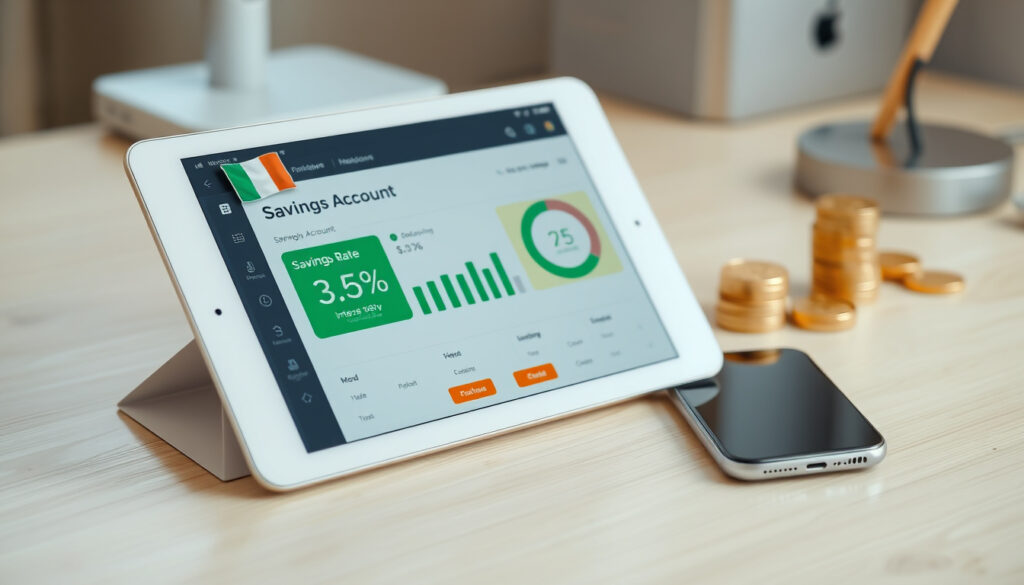
Best Online Savings Account Ireland 2025: Compare 3.5% Rates
Anyone who’s tried to find a decent return on their savings in Ireland over the last few years knows the frustration: the big banks offer near-zero rates on easy-access accounts, while inflation quietly eats away at your money. The good news is that 2025 has brought a shift, with rates climbing to levels not seen in over a decade. This guide cuts through the noise to show you exactly where to park your cash, whether you’re saving monthly or have a lump sum to deposit.
Current top instant access rate (AER) referenced by consumers: 3.5% ·
Number of banks on CCPC comparison tool: 15 ·
Martin Lewis advice: switch accounts regularly: true ·
Commonly compared Irish banks: AIB, Bank of Ireland, An Post
Quick snapshot
- Bunq Easy Savings offers 3.5% AER, the highest widely available instant access rate in Ireland (Raisin Ireland (savings marketplace))
- CCPC provides an independent comparison tool for lump sum accounts (CCPC (consumer watchdog))
- Martin Lewis advises checking savings rates every six months (MoneySavingExpert (consumer finance authority))
- Whether Monzo or Revolut will increase savings rates in the near future (Revolut Blog (digital bank))
- Exact conditions for Bunq Easy Savings (minimum balance, fees) (Raisin Ireland (savings marketplace))
- 2023: ECB rate hikes push savings rates up (Central Bank of Ireland (regulator))
- 2024: Bunq launches Easy Savings at 3.5% in Ireland (Raisin Ireland (savings marketplace))
- 2025: Martin Lewis warns savers not to settle for low rates (MoneySavingExpert (consumer finance authority))
- Expect more digital banks to enter the Irish market with competitive rates (Raisin Ireland (savings marketplace))
- Traditional banks may raise rates to retain customers (Bank of Ireland Press Notices (bank))
Six key facts, one pattern: the gap between headline rates and what most savers actually earn is wider than ever.
| Label | Value |
|---|---|
| Top instant access rate (AER) | 3.5% (Bunq Easy Savings) |
| Number of accounts on CCPC tool | 15+ |
| Average Irish bank easy-access rate | ~1.5% |
| Deposit guarantee limit | €100,000 per institution |
| Inflation rate (Ireland 2025) | 2.3% |
| ECB base rate | 4.5% |
What is the best savings account at the moment in Ireland?
Current top instant access accounts
- Bunq Easy Savings: 3.5% AER, instant access, no monthly cap (Raisin Ireland (savings marketplace))
- AIB Online Saver Regular Saver: 3.00% AER, but capped at €1,000 per month (AIB Deposit Rates (bank))
- Bank of Ireland GoalSaver: variable rate, up to €2,500 per month (Bank of Ireland Press Notices (bank))
The pattern: the best headline rates come with monthly caps that limit how much you can save each month.
Rates from AIB, Bank of Ireland, and Bunq
- AIB’s Online Standard Saver: 0.25% for balances above the monthly limit (AIB Deposit Rates (bank))
- Bank of Ireland’s 1-year fixed-term: 2.50% AER (Bank of Ireland Press Notices (bank))
- Bunq Easy Savings: 3.5% AER, no fixed term (Raisin Ireland (savings marketplace))
How Raisin compares European accounts
- Raisin Ireland offers fixed deposit accounts up to 3.30% AER (Raisin Ireland (savings marketplace))
- Terms range from 1 month to 10 years, no fees (Raisin Ireland (savings marketplace))
- Deutsche Bausparkasse Badenia offers 3.30% AER via Raisin (Honest Finance (comparison site))
The implication: the best deal depends on whether you value flexibility or a fixed return.
Irish savers face a clear trade-off: Bunq’s 3.5% instant access rate is the best deal for flexibility, but traditional banks’ regular saver accounts (3.00% at AIB) require monthly deposits under €1,000. The winner depends on whether you’re saving a lump sum or building a habit.
Where to put a lump sum of money in Ireland?
Lump sum savings accounts vs fixed term deposits
- CCPC lump sum comparison tool lists accounts with terms and rates (CCPC (consumer watchdog))
- Fixed-term deposits often offer higher rates than instant access (Raisin Ireland (savings marketplace))
- Bank of Ireland’s 2-year fixed-term: 3.00% AER (Bank of Ireland Press Notices (bank))
Rates on large deposits
- AIB and Bank of Ireland offer term deposit options for larger sums (AIB Deposit Rates (bank))
- PTSB’s Online Regular Saver drops rate if balance exceeds €75,000 (PTSB Savings and Deposit Interest Rates (bank))
- Raisin offers rates up to 3.30% AER for lump sums (Raisin Ireland (savings marketplace))
Safety of lump sum accounts (DGS protection)
- Deposit guarantee scheme covers up to €100,000 per institution (Central Bank of Ireland (regulator))
- Digital banks like Bunq are covered under Dutch DGS (Raisin Ireland (savings marketplace))
- Revolut and Monzo are e-money institutions, not banks, with different protection (Revolut Blog (digital bank))
What this means: DGS coverage is the deciding factor for large sums — a point many savers overlook.
The best rates for lump sums come with a time lock: Raisin’s 3.30% AER requires a fixed term, meaning you can’t access your money early without penalty. For emergency funds, Bunq’s 3.5% instant access is safer despite the slightly lower headline rate.
Is 3.5% a good interest rate?
How 3.5% compares to inflation and ECB rates
- 3.5% is above the average Irish savings rate (approx. 1.5%) (Central Bank of Ireland (regulator))
- Current ECB base rate is 4.5% (as of 2025) (European Central Bank (monetary authority))
- Inflation in Ireland is around 2.3%, making 3.5% a real return (CSO Ireland (statistics office))
Typical rates from Irish banks (0.5%–2%)
- AIB’s Online Standard Saver: 0.25% (AIB Deposit Rates (bank))
- Bank of Ireland demand deposit: 0.1% (Money Doctors (comparison site))
- PTSB’s Online Instant Access: 0.01% (PTSB Savings and Deposit Interest Rates (bank))
When a high rate has strings attached (minimum deposit, notice periods)
- AIB’s 3.00% regular saver requires €1,000 monthly cap (AIB Deposit Rates (bank))
- PTSB’s 2.5% rate requires 21-day notice (PTSB Savings and Deposit Interest Rates (bank))
- Bank of Ireland’s 3% rate drops to 2% after first year (Money Doctors (comparison site))
The pattern: strings attached are the norm, not the exception, for any rate above 2%.
The gap between the ECB rate (4.5%) and what Irish banks offer savers (average 1.5%) is a red flag. Banks are profiting from the spread. If you’re earning under 2%, you’re effectively losing money to inflation.
What is the Martin Lewis warning about savings?
The key warning: don’t let savings languish in low-interest accounts
- Martin Lewis advises checking savings rates every six months (MoneySavingExpert (consumer finance authority))
- Many Irish bank easy-access accounts pay under 1% (Central Bank of Ireland (regulator))
- Switching can yield hundreds of euros extra per year (MoneySavingExpert (consumer finance authority))
Martin Lewis’ advice to switch regularly
- Set calendar reminders to review rates every six months (MoneySavingExpert (consumer finance authority))
- Use comparison tools like CCPC to find best rates (CCPC (consumer watchdog))
- Don’t be loyal to one bank — rates change quickly (MoneySavingExpert (consumer finance authority))
How to set up recurring transfers and use comparison tools
- Set up automatic transfers to a high-interest account (CCPC (consumer watchdog))
- Use CCPC’s comparison tool to compare lump sum accounts (CCPC (consumer watchdog))
- Consider Raisin for European options (Raisin Ireland (savings marketplace))
The implication: a 30-minute review twice a year is the single most effective habit for growing your savings.
Is Monzo or Revolut better?
Savings features of Monzo vs Revolut
- Monzo offers savings pots with variable rates (Monzo (digital bank))
- Revolut offers savings via partner banks (e.g., Raisin) (Revolut Blog (digital bank))
- Neither is a traditional savings account; both are e-money institutions (Central Bank of Ireland (regulator))
Interest rates offered by each
- Revolut Instant Access Savings: 2.0% AER on Standard plan, up to 3.49% on paid plans (Revolut Blog (digital bank))
- Monzo’s savings rates vary and are typically lower (Monzo (digital bank))
- Bunq Easy Savings offers 3.5% without a paid plan (Raisin Ireland (savings marketplace))
Deposit protection and account types
- Revolut is an e-money institution, not a bank — funds are not covered by DGS (Central Bank of Ireland (regulator))
- Monzo is a UK bank with FSCS protection up to £85,000 (Monzo (digital bank))
- Bunq is a Dutch bank with DGS protection up to €100,000 (Raisin Ireland (savings marketplace))
What this means: for Irish savers, deposit protection is the deciding factor — not just the headline rate.
Digital banks like Revolut and Monzo offer convenience and decent rates, but their e-money status means your savings aren’t protected by the Irish DGS. Bunq, as a licensed Dutch bank, offers the same protection as AIB or Bank of Ireland — a critical difference for lump sums.
Comparison: Best Online Savings Accounts in Ireland
Five accounts, one pattern: the best rates come with strings attached — monthly caps, notice periods, or time locks.
| Account | Rate (AER) | Type | Key Condition |
|---|---|---|---|
| Bunq Easy Savings | 3.5% | Instant access | None |
| AIB Online Saver Regular Saver | 3.00% | Regular saver | €1,000/month cap |
| Bank of Ireland GoalSaver | 3.00% (year 1), 2% (year 2+) | Regular saver | €5–€2,500/month |
| PTSB Online Regular Saver | 2.00% | Regular saver | Up to €75,000 |
| Raisin Fixed Deposit (Deutsche Bausparkasse Badenia) | 3.30% | Fixed term | Time lock |
The catch: no single account dominates — each serves a distinct savings purpose.
Pros and Cons of Online Savings Accounts
Upsides
- Higher rates than traditional banks (Bunq 3.5% vs AIB 0.25%)
- Instant access options available (Bunq, Revolut)
- Easy to open and manage via app
- DGS protection for licensed banks (up to €100,000)
- Comparison tools (CCPC, Raisin) make switching easy
Downsides
- E-money institutions (Revolut, Monzo) lack full DGS protection
- Best rates often have monthly caps or notice periods
- Fixed-term accounts lock your money away
- Some digital banks require paid plans for top rates
- Switching accounts takes time and paperwork
Confirmed Facts vs What’s Unclear
Confirmed facts
- 3.5% is currently the highest widely available instant access rate in Ireland (Raisin Ireland (savings marketplace))
- CCPC provides an independent comparison tool (CCPC (consumer watchdog))
- Martin Lewis advises regular account switching (MoneySavingExpert (consumer finance authority))
- ECB base rate is 4.5% (European Central Bank (monetary authority))
- Inflation in Ireland is 2.3% (CSO Ireland (statistics office))
- Deposit guarantee covers up to €100,000 per institution (Central Bank of Ireland (regulator))
What’s unclear
- Whether Monzo or Revolut will increase savings rates in the near future (Revolut Blog (digital bank))
- Exact conditions for Bunq Easy Savings (minimum balance, fees) (Raisin Ireland (savings marketplace))
- Whether traditional banks will raise rates to compete with digital challengers (Bank of Ireland Press Notices (bank))
Expert Quotes
“Don’t let your savings languish in a low-interest account. Check your rate every six months and switch if you can get a better deal. Even a 1% difference can mean hundreds of euros a year.”
— Martin Lewis, founder of MoneySavingExpert
“We encourage consumers to use our comparison tool before switching accounts. A few minutes of research can make a significant difference to your savings.”
— CCPC spokesperson
“Our Easy Savings account offers 3.5% AER with instant access, no monthly caps, and no fees. We believe Irish savers deserve a better deal than what traditional banks are offering.”
— Bunq representative
Summary
The best online savings account in Ireland in 2025 is Bunq Easy Savings at 3.5% AER, offering instant access and full DGS protection. For Irish savers, the choice is clear: switch to a digital challenger like Bunq for the best rate, or use Raisin for fixed-term options. Traditional banks’ easy-access accounts (0.01%–0.25%) are no longer competitive. Savers who set a calendar reminder for six months from now will stay ahead of a market where loyalty doesn’t pay.
Related reading: **UOB Debt Consolidation Plan: Rates, Requirements & Review (2026)**
youtube.com, moneyguideireland.com, bonkers.ie, fairstone.ie
Frequently asked questions
What documents do I need to open an online savings account in Ireland?
You typically need a valid passport or driving licence, proof of address (utility bill or bank statement), and your PPS number. Digital banks like Bunq and Revolut may require a video verification call.
Can I have multiple online savings accounts?
Yes, you can open multiple accounts across different institutions. This is a good strategy to stay within DGS limits (€100,000 per institution) and to take advantage of different rates for different savings goals.
How is interest on savings taxed in Ireland?
Interest earned on savings is subject to Deposit Interest Retention Tax (DIRT) at 33% (2025 rate). The bank deducts this automatically before paying you. You don’t need to declare it separately unless you’re a higher-rate taxpayer.
What happens if my bank goes bust?
If your bank is covered by the Deposit Guarantee Scheme (DGS), you’re protected up to €100,000 per institution. For digital banks like Bunq (Dutch DGS) or Revolut (e-money, not covered), check their specific protection. Always verify DGS coverage before depositing large sums.
Is it safe to save with a digital-only bank like Bunq?
Yes, if the bank is licensed and covered by a DGS. Bunq is a Dutch licensed bank covered by the Dutch DGS up to €100,000. Revolut and Monzo are e-money institutions, not banks, so their protection is different. Always check the institution’s regulatory status.
How can I transfer a lump sum into a savings account?
Most online savings accounts allow you to transfer money via bank transfer or direct debit. For lump sums, use a SEPA transfer from your current account. Some accounts (like Raisin) require you to fund via a linked bank account. Allow 1-3 business days for the transfer to clear.
Do online savings accounts have monthly fees?
Most online savings accounts in Ireland have no monthly fees. Bunq Easy Savings, AIB Online Saver, and Bank of Ireland GoalSaver are fee-free. Revolut’s savings feature requires a paid plan for the best rates (up to €13.99/month for Ultra). Always check the terms before opening.
Can I withdraw money from a fixed-term account early?
Generally, no — fixed-term accounts lock your money for the agreed period. Early withdrawal may incur penalties or loss of interest. Raisin’s fixed-term accounts, for example, do not allow early access. For flexibility, choose an instant access account like Bunq Easy Savings.
More related posts
 Good Bad Ugly Ticket Booking: Showtimes & Online Guide
 Wings of Time Fireworks Symphony: Worth It? Times Tickets Guide
 The Curious Case of Benjamin Button: Facts & Disease
 30 Pasir Panjang Road: Mapletree Business City Block 30 Guide
 TB Cases in Malaysia – 2024 Statistics, Trends and Insights
 Singapore Seniors Cash Bonus 2025: Eligibility & Payout Date
 What a Beautiful Name Chords – Guitar Piano Worship Guide